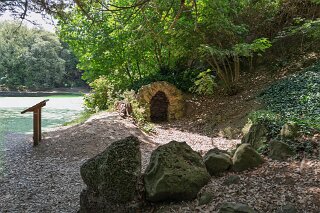
St Ann's Well At St Anne's Park Is A Holy Well Not A Wishing Well
Despite a nearby sign claiming it to be a "wishing well", St Ann’s Well bears no resemblance to the idyllic, bucket-and-pulley structures found in children's storybooks. Instead, the structure is the stone canopy of a disused holy well—its spring having run dry in the 1950s. The complete absence of coins inside the stone recess suggests that most visitors remain equally unconvinced by the modern wishing well label.
Photographing the now dry holy well presents a minor challenge due to the dense canopy of surrounding trees, which keeps the stonework in deep shade throughout the day.
Historical Context & Restoration
Located within St Anne’s Park—Dublin’s second-largest municipal park and the former estate of the Guinness family—the well is situated just beyond the old artificial lake, near the Roman temple folly and below the Watchtower, close to the main coastal entrance.
Historically a revered holy well, St Ann's Well gave its name (with a slightly altered spelling) to the surrounding St Anne's estate. Note: In religious tradition, both names refer to the exact same figure: Saint Anne (from Hebrew Ḥannāh, meaning "grace"), mother of Mary.
The original spring dried up in the 1950s due to urban development and alterations in the local water table. Although Dublin City Council made several attempts to locate and redirect the source, the well remains dry. Despite this, the site retains local heritage significance; in July 2000, it hosted an ecumenical procession with parishioners from both the local Roman Catholic and Church of Ireland churches. In early 2018, specialist contractors cleared accumulated soil and vegetation, rediscovered the original opening, and installed a protective safety grille to keep out falling leaves and debris.
Holy Well vs. "Wishing Well"
The board designating the site as a wishing well stems from a community storytelling trail created by Transition Year students from Ardscoil La Salle in partnership with Fighting Words and Dublin City Council. While such creative initiatives are well-intentioned for younger park visitors, "wishing wells" are essentially an Anglo-American fairytale trope rather than an authentic Irish tradition.
Ireland’s heritage rests on thousands of ancient holy wells (Tobar Naofa), historically associated with healing rituals, saint veneration, and offerings like clooties (cloth strips) or small pins—not tossing coins for personal wishes. While a bit of imaginative storytelling in a park is harmless enough, presented on official-looking signage without historical context, it risks blurring the line between local folklore and genuine history. An accurate account of St Ann's Well and its origins as a sacred spring offers a far richer connection to Dublin's past.