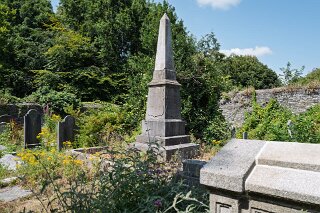
THIS WAS MY FIRST TIME TO VISIT THIS OLD GRAVEYARD
ST JOHN THE BAPTIST CEMETERY IN CLONTARF [HERITAGE AND CASTLE CONNECTIONS]
My mother, after a hip operation, spent a few weeks in Clontarf Hospital and as all family members were overseas at the time I had the responsibility to visit her every day but I was unaware of St John The Baptist Cemetery around the corner from where my mother was even though I had explored the area in great detail - I actually walked by the cemetery but thought that it was an entrance to Clontarf Castle. About three years ago a friend of mine suggested that I should photograph the cemetery where Maureen Potter was buried but I ended up photographing a different graveyard known as the Kilbarrack Burial Site and I will also discuss that location below and I plan to photograph it again in August
St John The Baptist Cemetery, Clontarf: History, Heritage, and Castle Connections
Tucked away along Castle Avenue behind a grand Tudor-arched gateway, the historic ruined church and graveyard of St John the Baptist offers a quiet window into the multi-layered history of Clontarf. While thousands pass by daily on their way towards the sea or Clontarf Castle, this sacred enclosure holds centuries of coastal Dublin’s history within its ivy-draped limestone walls.
Early Origins and Monastic History
The history of the site stretches back well over a millennium. Long before the present ruined church was constructed, a monastic settlement was established here around 550 AD by St Comgall and his followers. For centuries, St Comgall was revered as the original patron saint of Clontarf.
Following the Anglo-Norman arrivals in the 12th century, King Henry II granted the lands of Clontarf to the monastic military order of the Knights Templar. When the Templars were suppressed in 1312, control passed to the Knights Hospitaller (the Knights of St John of Jerusalem). It was under their guardianship that the dedication of the parish shifted from St Comgall to St John the Baptist—a moniker the parish retains to this day.
Around 1609, a new Protestant parish church was erected on the foundations of the earlier medieval buildings. This structure served as the primary Church of Ireland place of worship for Clontarf for over 250 years. It was in this very church that Dracula author Bram Stoker was baptised in December 1847. By 1866, the growing parish population necessitated a larger building, leading to the construction of the present St John the Baptist Church on Seafield Road West, after which the old building fell into peaceful ruin.
Relationship to Clontarf Castle
The cemetery and church ruins share an undeniable, symbiotic relationship with neighbouring Clontarf Castle, situated just a short stroll up Castle Avenue.
1172 : Lands granted to Anglo-Normans & Knights Templar
1312 : Knights Hospitaller take ownership of Castle & Site
1649 : Vernon family takes possession of the Castle Estate
1837 : Gothic remodelling of Castle & Graveyard Gateway
Shared Feudal Estates: For centuries, the ecclesiastical site and the Castle were dual anchors of the local manor. Whichever power held the Castle—whether the Knights Templar, the Knights Hospitaller, or private landlords—exercised patronage over the church and graveyard.
The Vernon Family Legacy: Following the Cromwellian confiscations in 1649, Clontarf Castle and its surrounding lands passed to Quartermaster General John Vernon. The Vernon family ruled as Lords of Clontarf for over 300 years, and St John the Baptist cemetery served as their family burial ground, containing multiple generation plots.
Architectural Cohesion: The ornate dressed-limestone pedestrian entrance to the cemetery, featuring a pitched slate roof and Tudor arch, was constructed around 1840. This design directly echoes the dramatic Gothic revival remodelling of Clontarf Castle undertaken in 1837 by architect William Vitruvius Morrison.
Notable Burials and Figures of Interest
Despite starting primarily as a Church of Ireland burial site, St John the Baptist cemetery accommodated burials across religious denominations, creating a diverse cross-section of Dublin society—from landed gentry and military commanders to mariners and revolutionaries.
Maureen Potter (1925–2004)
Legendary comedian, actress, and pantomime dame, Maureen Potter was a true icon of Irish theatre and variety entertainment for over six decades. Born in nearby Fairview, she lived for many years in Clontarf before passing away at her home in 2004. Granted the Freedom of the City of Dublin in 1984, she rests in the cemetery close to the local community that knew and cherished her.
The Vernon Family Plots
Members of the Vernon dynasty who shaped modern Clontarf, oversaw the development of Castle Avenue, and managed the estate from 1649 until the mid-20th century.
Sean and Esther O'Moore (1916 Easter Rising Veterans) - A prominent republican couple buried together in the graveyard. Sean O'Moore fought at the Four Courts under Commandant Ned Daly during the 1916 Rising and later served as Officer Commanding of the 1st Battalion, Dublin Brigade during the War of Independence. His wife, Esther Wisely O'Moore, served in the GPO alongside Patrick Pearse and James Connolly.
Captain Joseph Massey (d. 1799) - A merchant navy captain from New Haven, Sussex, whose flat gravestone records his tragic death when his ship was wrecked off Dublin Port during a violent storm on 1 February 1799—a day that claimed five vessels in Dublin Bay.
Local Merchant & Gentry Families
The cemetery holds the plots of several families who influenced Dublin’s commercial life, including the Oultans, Greshams, Drums, and McDevitts. The oldest recorded grave marker on site dates back to Katherine Kirke, who died in 1641.