Pomodoro Sphere Within A Sphere At Trinity College Dublin
The Urban Cartographer
Explore the history behind Arnaldo Pomodoro’s iconic bronze sculpture, Sfera con Sfera, situated on the forecourt of the Eavan Boland Library at Trinity College Dublin. Discover how the piece succeeded Henry Moore’s King and Queen to become a masterclass in modern public art and brutalist architectural dialogue.
MOBILE FRIENDLY AND MUCH FASTER
GO THERE
MURALS BY SHANE SUTTON
Leica Q3
Presented By William Murphy - The Urban Cartographer - LEICA Q3 Photographed 9 October 2026
Pomodoro Sphere Within A Sphere At Trinity College Dublin
Author: William Murphy - The Urban Cartographer
|
11. Oct 2026
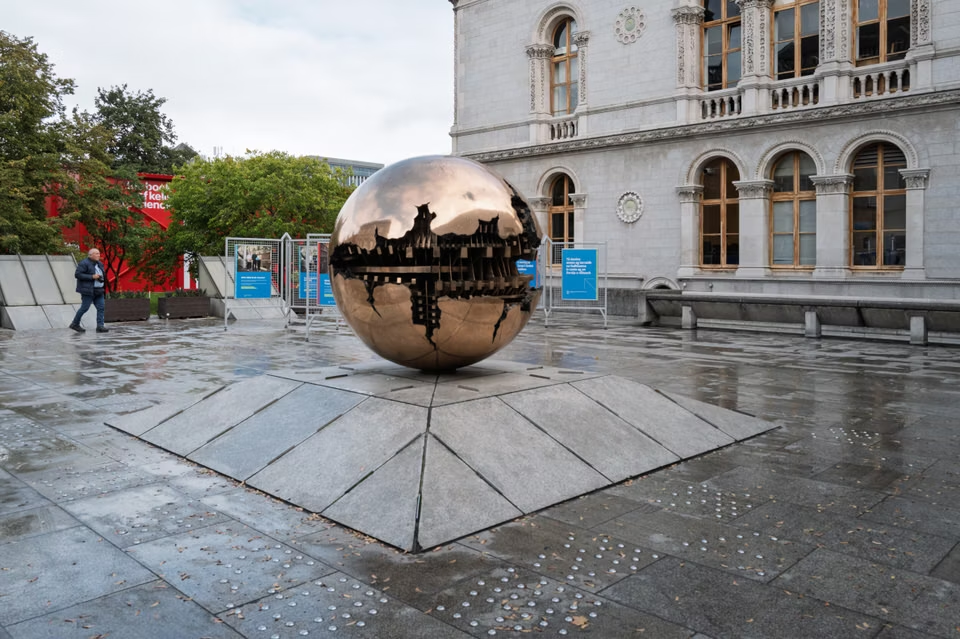
THE LEICA Q3 PERFORMED MUCH BETTER TODAY The Urban Cartographer Presents: Photographed By William Murphy Using A Leica Q3 The Sphere on the Forecourt: Art, Architecture, and Arnaldo Pomodoro at Trinity College Dublin Standing on the granite forecourt outside the Eavan Boland Library at Trinity College Dublin, one struggles to imagine the space without its defining visual anchor: a monumental bronze orb, fractured open to reveal an intricate, gear-like core. Arnaldo Pomodoro’s Sfera con Sfera (Sphere Within Sphere) has become central to the university’s modern architectural identity. Yet its commanding position was neither accidental nor an immediate choice; it was the culmination of an ambitious search following a high-profile artistic impasse. Before the bronze sphere was installed, another modern master stood sentinel over the plaza. In the late 1960s, the celebrated British sculptor Henry Moore loaned his figurative bronze, The King and Queen, to Trinity College. Set against Paul Koralek’s 1967 Brutalist library, the loan aimed to spark a creative dialogue between humanistic modern sculpture and bush-hammered concrete. The pairing, however, proved discordant to the sculptor: Concluding that the site compromised his creative vision, Moore requested the sculpture’s return. Trinity honoured his wishes, leaving an awkward spatial vacuum across one of the campus's most prominent public arenas. Determined to find an artwork that could command rather than succumb to the architecture, Trinity sought a piece with sufficient scale, mass, and surface dynamism to animate a hard-edged, shaded plaza. The acquisition proved to be a natural convergence of interests. While the college searched internationally for a focal point of genuine stature, Italian sculptor Arnaldo Pomodoro was expanding his seminal series of ruptured spheres across high-profile architectural contexts—including the Vatican Museums and the United Nations Plaza in New York. In 1982, Pomodoro generously gifted the primary bronze casting to Trinity College. Through combined funding from the university, Italian cultural institutions, and private benefactors, the necessary mounting infrastructure and logistical operations were assembled. When Sfera con Sfera was mounted on its low granite plinth in 1983, the forecourt found its ideal counterweight. Born in 1926 in Morciano di Romagna, Pomodoro trained in goldsmithing and stage design before shifting toward monumental sculpture. This grounding in fine metal craft and spatial drama informs his hallmark practice: slicing into pristine geometric volumes—spheres, obelisks, and discs—to expose dense, labyrinthine mechanics within. Sfera con Sfera relies on visual and philosophical tension: Pomodoro’s sphere commands the forecourt precisely where Moore’s figurative piece struggled, resolving the plaza's visual challenges through three key dynamics: Rather than resisting the plaza's difficult conditions, Sfera con Sfera absorbs and reflects them, turning the surrounding environment into an active part of the composition. Completed in 1967 as the "New Library" to house Trinity College’s growing legal deposit collection, Paul Koralek’s landmark building was dedicated in 1978 as the Berkeley Library in honour of 18th-century philosopher and alumnus George Berkeley. In April 2023, following student advocacy and an evidence-based investigation by the Trinity Legacies Review Working Group, the University Board voted to dename the library. The decision addressed historical records confirming Berkeley’s ownership of enslaved people on his Rhode Island plantation in the 1730s, alongside his published arguments supporting the enslavement of Indigenous and African populations. The university resolved that retaining the dedication directly contradicted its commitments to equality and inclusion. Following a public consultation drawing over 800 submissions, the building was officially renamed the Eavan Boland Library in October 2024. Commemorating the celebrated Irish poet, essayist, and Trinity alumna (1944–2020), it represents the first building on Trinity's historic main campus dedicated to a woman. Photographing high-polish, fractured bronze like Pomodoro’s Sfera con Sfera with the fixed 28mm f/1.7 Summilux on the Leica Q3 requires balancing specular highlights, complex internal shadows, and the wide-angle perspective. Mind Wide-Angle Distortion: A 28mm lens exaggerates perspective close-up. If the sphere is placed too close to the edge of the frame, the optical volume will stretch into an unnatural oval. Keep the main spherical volume relatively central to maintain its true geometric proportions. Contextual Grounding: Use the 28mm field of view to capture the dialogue between the sculpture and Paul Koralek’s Brutalist library facade. Shoot in landscape orientation from waist level, using the Q3's tiltable screen to align the horizontal lines of the library's board-marked concrete with the sphere's plinth. Leica Digital Crop Modes: When isolating the intricate, gear-like interior, the 60MP sensor provides significant resolution flexibility: 35mm Crop (~39 MP): Tighter environmental frame that excludes busy pedestrian traffic. 50mm Crop (~20 MP): Ideal for zeroing in on the ruptured fissure, isolating the mechanical core without introducing wide-angle foreground distortion. Macro Mode Engagement: For extreme detail shots of the patinated bronze teeth and chiselled internal markings, rotate the Summilux collar to Macro Mode (focusing down to 17 cm). Step down to f/4 to ensure the textural depth inside the rupture stays crisp.
Pomodoro Sphere Within A Sphere
At Trinity College Dublin
The Precursor: Henry Moore’s Departure
Securing the Pomodoro Sphere
Deconstructing Sfera con Sfera
Why the Site Works
Historical Note: The Eavan Boland Library
Using The Leica Q3
1. Camera Settings & Exposure Strategy
2. Working with Light and Surface Reflections
3. Composition & the 28mm Focal Length
Other Topics That May Be Of Interest
[[shortcode.limerick.0002]]
[[shortcode.newstreetwaterford.0002]]
THE LEGACY CATALOG
Examples Of Waterford Walls Murals
HIGH RESOLUTION PHOTOGRAPHS PLUS MAP
Leica Q3
LET MISTER SCREEN DIRECT YOU
GLOBAL INDEX OF PHOTO GALLERIES
DEANSGRANGE CEMETERY
THE URBAN CARTOGRAPHER
MURALS BY SHANE SUTTON
Pomodoro Sphere Within A Sphere At Trinity College Dublin - Presented By The William Murphy - The Urban Cartographer