THE STORY BEHIND THE KISS BY ROWAN GILLESPIE
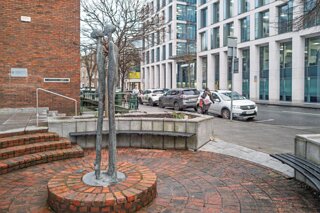
THE STORY BEHIND THE KISS BY ROWAN GILLESPIE [PHOTOGRAPHED 22 DECEMBER 2025]
Dublin’s Hidden Gem of Romance: The Story Behind Rowan Gillespie’s "The Kiss"
In a city famous for its statues of patriots and poets, it is easy to overlook the quieter, more intimate stories cast in bronze on Dublin's streets. Yet, situated on Earlsfort Terrace, just across from the National Concert Hall, stands one of the city's most tender artistic treasures: "The Kiss" by celebrated Irish sculptor Rowan Gillespie.
Unlike the imposing monuments of O'Connell Street, this sculpture invites you to pause, reflect, and witness a frozen moment of pure connection.
The Art of Anticipation
Commissioned in 1989 for the Earlsfort Centre, "The Kiss" is not a depiction of a Hollywood embrace. Instead, it captures something far more electric: anticipation. The two abstract figures lean toward one another, their bodies elongated and elegant, with lips that are agonisingly close but—crucially—not quite touching.
Gillespie himself has described this specific split-second as "that tingly tentative moment just before lips touch for the first time." It is a masterclass in tension, capturing the shared breath and the invisible magnetic pull between two people before the physical act occurs.
Inspiration and Meaning
Rowan Gillespie (born 1953) is known for his ability to convey raw human emotion through the cold medium of bronze. While he is perhaps most famous for the haunting "Famine" memorial on Custom House Quay, "The Kiss" reveals a softer, more personal side of his work.
The piece is widely cited as being influenced by the spiritual writings of Khalil Gibran, specifically The Prophet. Gibran’s philosophy on love emphasises "growing together" while retaining one's own space—captured perfectly here by the two distinct pillars of bronze that curve together to form a single archway of intimacy. The sculpture suggests that true connection creates a personal sanctuary, a quiet space in the middle of a bustling city.
Why You Should Visit
"The Kiss" offers a stark, peaceful contrast to the noise of modern Dublin. It stands as a reminder that amidst the daily grind (and the corporate offices of Eversheds Sutherland that it sits outside), there is always room for tenderness.
Photographer's Tip: The elongated vertical lines of the sculpture create a stunning silhouette against the Dublin sky. Try visiting in the late afternoon when the light catches the texture of the bronze.
Quick Facts
Artist: Rowan Gillespie (b. 1953)
Location: Earlsfort Terrace, Dublin 2 (Corner of Hatch Street, opposite the National Concert Hall).
Material: Bronze (Lost-wax casting method).
Date: 1989/1990.
Theme: Love, anticipation, and spiritual connection.
Dublin’s Hidden Gem of Romance: The Story Behind Rowan Gillespie’s "The Kiss"
In a city famous for its statues of patriots and poets, it is easy to overlook the quieter, more intimate stories cast in bronze on Dublin's streets. Yet, situated on Earlsfort Terrace, just across from the National Concert Hall, stands one of the city's most tender artistic treasures: "The Kiss" by celebrated Irish sculptor Rowan Gillespie.
Unlike the imposing monuments of O'Connell Street, this sculpture invites you to pause, reflect, and witness a frozen moment of pure connection.
The Art of Anticipation
Commissioned in 1989 for the Earlsfort Centre, "The Kiss" is not a depiction of a Hollywood embrace. Instead, it captures something far more electric: anticipation. The two abstract figures lean toward one another, their bodies elongated and elegant, with lips that are agonisingly close but—crucially—not quite touching.
Gillespie himself has described this specific split-second as "that tingly tentative moment just before lips touch for the first time." It is a masterclass in tension, capturing the shared breath and the invisible magnetic pull between two people before the physical act occurs.
Inspiration and Meaning
Rowan Gillespie (born 1953) is known for his ability to convey raw human emotion through the cold medium of bronze. While he is perhaps most famous for the haunting "Famine" memorial on Custom House Quay, "The Kiss" reveals a softer, more personal side of his work.
The piece is widely cited as being influenced by the spiritual writings of Khalil Gibran, specifically The Prophet. Gibran’s philosophy on love emphasises "growing together" while retaining one's own space—captured perfectly here by the two distinct pillars of bronze that curve together to form a single archway of intimacy. The sculpture suggests that true connection creates a personal sanctuary, a quiet space in the middle of a bustling city.
Why You Should Visit
"The Kiss" offers a stark, peaceful contrast to the noise of modern Dublin. It stands as a reminder that amidst the daily grind (and the corporate offices of Eversheds Sutherland that it sits outside), there is always room for tenderness.
Photographer's Tip: The elongated vertical lines of the sculpture create a stunning silhouette against the Dublin sky. Try visiting in the late afternoon when the light catches the texture of the bronze.
Quick Facts
Artist: Rowan Gillespie (b. 1953)
Location: Earlsfort Terrace, Dublin 2 (Corner of Hatch Street, opposite the National Concert Hall).
Material: Bronze (Lost-wax casting method).
Date: 1989/1990.
Theme: Love, anticipation, and spiritual connection.
THE KISS SCULPTURE