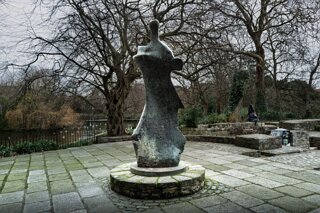
SCULPTURE LOCATED IN ST STEPHEN'S GREEN DUBLIN - 14 FEBRUARY 2026
STANDING ON THE KNIFE EDGE [HENRY MOORE'S TRIBUTE TO W.B.YEATS]
Standing on the Knife Edge: Henry Moore’s Tribute to W.B. Yeats
Nestled within the verdant landscape of St Stephen’s Green, Dublin, stands Standing Figure: Knife Edge. This cast bronze monument serves as a profound, abstract memorial to the Nobel Prize-winning Irish poet W.B. Yeats. Commissioned by a committee of the poet’s admirers and unveiled in 1967—nearly three decades after Yeats’s death—the sculpture represents a landmark intersection of 20th-century literature and modern art.
Artistic Form and Setting
The sculpture is a masterclass in Henry Moore’s signature style. Its "knife-edge" quality refers to the thinning of the bronze into sharp, blade-like profiles that contrast with its broader, more voluminous surfaces. This creates a sense of dynamic, almost precarious balance, as if the form is shifting in the wind—a fitting metaphor for the ethereal nature of Yeats’s poetry.
Though the sculpture is abstract, it echoes the upright dignity of a human figure. It sits upon a low, circular metal base, which rests on a rugged granite plinth integrated into a cobbled, paved garden. This specific site once housed the park's Victorian glasshouses; today, the area is designed with stepped seating, encouraging visitors to linger and contemplate the dialogue between the bronze and the surrounding flora.
The Symbolism of Abstraction
While many memorials in St Stephen’s Green are traditional representational busts, Moore’s work is a rare departure into abstraction. This choice was deliberate. Rather than a literal likeness, the sculpture captures the essence of Yeats—a man whose work bridged the gap between ancient Irish mythology and modernist experimentation. The hollows and pierced forms, characteristic of Moore’s "truth to materials" philosophy, invite the light and landscape to pass through the work, mirroring Yeats’s own preoccupation with the interplay between the physical and spiritual worlds.
The Plaque Reads:
"W.B. Yeats 1865-1939. A tribute in bronze by Henry Moore. Erected by admirers of the poet October 1967."
The Visionaries Behind the Work
W.B. Yeats (1865–1939): A titan of 20th-century literature and a pillar of the Irish Literary Revival. Yeats’s work evolved from the romantic "Celtic Twilight" of his youth to the spare, powerful modernism of his later years. As a playwright and co-founder of the Abbey Theatre, his influence on Irish national identity remains unparalleled.
Henry Moore (1898–1986): The pre-eminent British sculptor of his era. Moore believed that "sculpture is an art of the open air," and he championed the idea that his works should be touched and weathered by the elements. The Knife Edge series (variants of which appear in London and New York) remains one of his most celebrated explorations of the human form reduced to its most vital, rhythmic essentials.
Standing on the Knife Edge: Henry Moore’s Tribute to W.B. Yeats
Nestled within the verdant landscape of St Stephen’s Green, Dublin, stands Standing Figure: Knife Edge. This cast bronze monument serves as a profound, abstract memorial to the Nobel Prize-winning Irish poet W.B. Yeats. Commissioned by a committee of the poet’s admirers and unveiled in 1967—nearly three decades after Yeats’s death—the sculpture represents a landmark intersection of 20th-century literature and modern art.
Artistic Form and Setting
The sculpture is a masterclass in Henry Moore’s signature style. Its "knife-edge" quality refers to the thinning of the bronze into sharp, blade-like profiles that contrast with its broader, more voluminous surfaces. This creates a sense of dynamic, almost precarious balance, as if the form is shifting in the wind—a fitting metaphor for the ethereal nature of Yeats’s poetry.
Though the sculpture is abstract, it echoes the upright dignity of a human figure. It sits upon a low, circular metal base, which rests on a rugged granite plinth integrated into a cobbled, paved garden. This specific site once housed the park's Victorian glasshouses; today, the area is designed with stepped seating, encouraging visitors to linger and contemplate the dialogue between the bronze and the surrounding flora.
The Symbolism of Abstraction
While many memorials in St Stephen’s Green are traditional representational busts, Moore’s work is a rare departure into abstraction. This choice was deliberate. Rather than a literal likeness, the sculpture captures the essence of Yeats—a man whose work bridged the gap between ancient Irish mythology and modernist experimentation. The hollows and pierced forms, characteristic of Moore’s "truth to materials" philosophy, invite the light and landscape to pass through the work, mirroring Yeats’s own preoccupation with the interplay between the physical and spiritual worlds.
The Plaque Reads:
"W.B. Yeats 1865-1939. A tribute in bronze by Henry Moore. Erected by admirers of the poet October 1967."
The Visionaries Behind the Work
W.B. Yeats (1865–1939): A titan of 20th-century literature and a pillar of the Irish Literary Revival. Yeats’s work evolved from the romantic "Celtic Twilight" of his youth to the spare, powerful modernism of his later years. As a playwright and co-founder of the Abbey Theatre, his influence on Irish national identity remains unparalleled.
Henry Moore (1898–1986): The pre-eminent British sculptor of his era. Moore believed that "sculpture is an art of the open air," and he championed the idea that his works should be touched and weathered by the elements. The Knife Edge series (variants of which appear in London and New York) remains one of his most celebrated explorations of the human form reduced to its most vital, rhythmic essentials.
HENRY MOORE