URBAN EXPRESSION AND DEPRESSION THE 28-70MM SESSION
Urban Depression and Expression: The Scars and Art of Belfast’s Forgotten Quarter
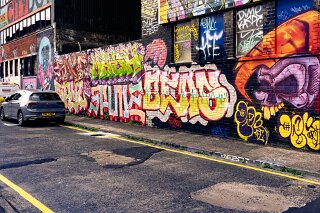
Look at the walls bounded by North Street, Winetavern Street, and Gresham Street today, and you will see a vibrant explosion of colour. The street art here is world-class—a striking testament to human creativity. But as a photographer who has documented this city since 2005, I see something deeper beneath the paint. My images capture a profound juxtaposition: a raw tension between urban depression and artistic expression.
To truly understand these photographs, you have to look past the canvas and look into the canvas's history. This isn't just an edgy, repurposed urban zone; it is a landscape of frozen trauma, scarred by geopolitics, economic abandonment, and a line of history that stretches right back to my own childhood.
Shadows of the Blitz: A Child’s Eye View
My connection to this pavement goes back to 1956. I was just six or seven years old, visiting Belfast from my home in Muff, County Donegal. Even though we lived right on the border just a few miles outside Derry, it was Belfast we would travel to once a month to do our major shopping, often gravitating toward the bustling, labyrinthine heart of the old Smithfield Market.
Even then, the area was defined by sprawling, semi-derelict gravel parking lots. When I asked about them, my father pointed to the jagged spaces between the remaining buildings and told me they were Second World War bomb sites.
He was right. Fifteen years earlier, during the 1941 Belfast Blitz, the Luftwaffe dropped thousands of incendiary and high-explosive bombs right here, gutting the commercial heart of the city. In the lean, post-war decades, building materials were rationed. Rather than rebuilding, the city simply paved over the craters, turning wounds into temporary car parks.
It was on one of those very corners that my father bought us two Regency TR-1 transistor radios—the world’s first commercial portable radios, newly imported from America. They cost an astronomical £30 each (nearly a month’s wages back then), a purchase that caused a minor family crisis when my mother realised he hadn’t bought one for her! Yet, that high-tech piece of American engineering purchased amidst the ruins sparked a fascination that defined my life: it was the exact moment I decided to become an electronics engineer.
From Wartime Ruin to Political Paralysis
The "temporary" car parks of my childhood never went away. Just as Belfast began to find its footing in the 1960s, the Troubles began. And it should be noted that I avoided the City and all of Northern Ireland until 2005.
Because North Street and Smithfield sat on the friction lines between the commercial centre and volatile districts of North and West Belfast, it became a frequent target. In 1974, an IRA incendiary attack completely destroyed the historic Victorian Smithfield Market building. Security barriers and checkpoints went up, creating a "Ring of Plastic" around the city centre. Foot traffic dried up, businesses fled, and the area entered a profound state of urban depression.
[1941: Blitz Craters] ➔
[1950s: Bomb Site Car Parks] ➔
[1970s: Troubles Bombing & Abandonment]
The Modern Stagnation: Why the Decay Continued
When I began photographing this sector of the city in 2005, I expected to document its renewal. Instead, I captured a continuation of its decay. Over the last two decades, this quarter has been trapped in a modern cycle of neglect driven by speculative property trading.
Vast blocks were bought up by developers for a massive, multi-million-pound retail and commercial scheme called "Tribeca Belfast." But the global financial crash of 2008 froze development, and the buildings were boarded up and left to rot. While the shiny, new Victoria Square development revitalised the opposite side of the city centre, it actively sucked the remaining retail life out of old thoroughfares like North Street and Gresham Street.
Expression And Depression
The Raw Canvas: Winetavern & Gresham Street
On Winetavern Street and Gresham Street, the art is fast, raw, and reactive. It covers temporary corrugated iron fences, boarded-up shop windows, and the edges of surface-level car parks. It is fundamentally "meanwhile use"—a bright plaster covering a deep structural wound that has remained unhealed since 1941. The vibrant, rebellious energy of the paint thrives precisely because the buildings beneath them have been left to decay.
The Master Canvas: Union, Kent, and Library Street
Walk just a few yards further into Union Street, Kent Street, and Library Street, and the aesthetic shifts entirely. With a few exceptions, the street art here tends to be of significantly greater interest to the serious observer.
This pocket forms the spiritual and cultural epicentre of Belfast’s world-class street art movement. Thanks to the annual Hit the North street art festival, these streets have been treated not just as abandoned surfaces to be covered, but as a curated open-air gallery. Here, you encounter massive, towering multi-storey murals executed by international master artists.
At the heart of this zone stands the Sunflower Public House on the corner of Kent Street and Union Street. It famously retains its 1980s security cage at the front door—a literal relic of the Troubles—but it now looks out over a streetscape redefined by high-concept, highly polished visual expression.
By grouping these streets together in a single gallery, the true narrative of the area reveals itself. The towering, complex murals on Kent and Union Street show how a creative community can reclaim a formally abandoned, heavily securitised zone and turn it into a celebrated cultural destination. Yet they stand side-by-side with the fractured, raw boards of Winetavern Street.
When you look at my photographs of these walls, you are looking at eighty-five years of Belfast history: a line running from Luftwaffe bombers to a young boy buying an American radio, through the dark days of the Troubles, right up to the modern artists who refuse to let the city’s forgotten corners fade into grey obscurity.
Look at the walls bounded by North Street, Winetavern Street, and Gresham Street today, and you will see a vibrant explosion of colour. The street art here is world-class—a striking testament to human creativity. But as a photographer who has documented this city since 2005, I see something deeper beneath the paint. My images capture a profound juxtaposition: a raw tension between urban depression and artistic expression.
To truly understand these photographs, you have to look past the canvas and look into the canvas's history. This isn't just an edgy, repurposed urban zone; it is a landscape of frozen trauma, scarred by geopolitics, economic abandonment, and a line of history that stretches right back to my own childhood.
Shadows of the Blitz: A Child’s Eye View
My connection to this pavement goes back to 1956. I was just six or seven years old, visiting Belfast from my home in Muff, County Donegal. Even though we lived right on the border just a few miles outside Derry, it was Belfast we would travel to once a month to do our major shopping, often gravitating toward the bustling, labyrinthine heart of the old Smithfield Market.
Even then, the area was defined by sprawling, semi-derelict gravel parking lots. When I asked about them, my father pointed to the jagged spaces between the remaining buildings and told me they were Second World War bomb sites.
He was right. Fifteen years earlier, during the 1941 Belfast Blitz, the Luftwaffe dropped thousands of incendiary and high-explosive bombs right here, gutting the commercial heart of the city. In the lean, post-war decades, building materials were rationed. Rather than rebuilding, the city simply paved over the craters, turning wounds into temporary car parks.
It was on one of those very corners that my father bought us two Regency TR-1 transistor radios—the world’s first commercial portable radios, newly imported from America. They cost an astronomical £30 each (nearly a month’s wages back then), a purchase that caused a minor family crisis when my mother realised he hadn’t bought one for her! Yet, that high-tech piece of American engineering purchased amidst the ruins sparked a fascination that defined my life: it was the exact moment I decided to become an electronics engineer.
From Wartime Ruin to Political Paralysis
The "temporary" car parks of my childhood never went away. Just as Belfast began to find its footing in the 1960s, the Troubles began. And it should be noted that I avoided the City and all of Northern Ireland until 2005.
Because North Street and Smithfield sat on the friction lines between the commercial centre and volatile districts of North and West Belfast, it became a frequent target. In 1974, an IRA incendiary attack completely destroyed the historic Victorian Smithfield Market building. Security barriers and checkpoints went up, creating a "Ring of Plastic" around the city centre. Foot traffic dried up, businesses fled, and the area entered a profound state of urban depression.
[1941: Blitz Craters] ➔
[1950s: Bomb Site Car Parks] ➔
[1970s: Troubles Bombing & Abandonment]
The Modern Stagnation: Why the Decay Continued
When I began photographing this sector of the city in 2005, I expected to document its renewal. Instead, I captured a continuation of its decay. Over the last two decades, this quarter has been trapped in a modern cycle of neglect driven by speculative property trading.
Vast blocks were bought up by developers for a massive, multi-million-pound retail and commercial scheme called "Tribeca Belfast." But the global financial crash of 2008 froze development, and the buildings were boarded up and left to rot. While the shiny, new Victoria Square development revitalised the opposite side of the city centre, it actively sucked the remaining retail life out of old thoroughfares like North Street and Gresham Street.
Expression And Depression
The Raw Canvas: Winetavern & Gresham Street
On Winetavern Street and Gresham Street, the art is fast, raw, and reactive. It covers temporary corrugated iron fences, boarded-up shop windows, and the edges of surface-level car parks. It is fundamentally "meanwhile use"—a bright plaster covering a deep structural wound that has remained unhealed since 1941. The vibrant, rebellious energy of the paint thrives precisely because the buildings beneath them have been left to decay.
The Master Canvas: Union, Kent, and Library Street
Walk just a few yards further into Union Street, Kent Street, and Library Street, and the aesthetic shifts entirely. With a few exceptions, the street art here tends to be of significantly greater interest to the serious observer.
This pocket forms the spiritual and cultural epicentre of Belfast’s world-class street art movement. Thanks to the annual Hit the North street art festival, these streets have been treated not just as abandoned surfaces to be covered, but as a curated open-air gallery. Here, you encounter massive, towering multi-storey murals executed by international master artists.
At the heart of this zone stands the Sunflower Public House on the corner of Kent Street and Union Street. It famously retains its 1980s security cage at the front door—a literal relic of the Troubles—but it now looks out over a streetscape redefined by high-concept, highly polished visual expression.
By grouping these streets together in a single gallery, the true narrative of the area reveals itself. The towering, complex murals on Kent and Union Street show how a creative community can reclaim a formally abandoned, heavily securitised zone and turn it into a celebrated cultural destination. Yet they stand side-by-side with the fractured, raw boards of Winetavern Street.
When you look at my photographs of these walls, you are looking at eighty-five years of Belfast history: a line running from Luftwaffe bombers to a young boy buying an American radio, through the dark days of the Troubles, right up to the modern artists who refuse to let the city’s forgotten corners fade into grey obscurity.
EXPRESSION AND DEPRESSION