MORE LIKE LIVING IN REVELATIONS THAN IN ENGLAND
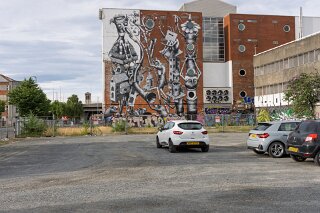
MORE LIKE LIVING IN REVELATIONS THAN IN ENGLAND [THE BUILDING FEATURING THIS MURAL IS DUE TO BE REPLACED BY A PBMSA]
More Like Living in Revelations Than in England
"A Desert with Windows"
While setting up my shots in the dark, I had a brief chat with a local who was passing by. As we looked up at the towering, repetitive glass facades of the nearby student high-rises, they described the area with four words that have stayed with me ever since: "A desert with windows."
It is an incredibly accurate, devastatingly poetic summary of Belfast’s current urban trajectory. From a distance, the new skyline looks modern and active. But on the ground, once the offices close and the lecture halls empty, there is no life on the pavement. There is no spontaneous civic character—just a barren landscape of concrete and glass where the windows serve as transient boxes rather than the eyes of a vibrant, multi-generational neighbourhood.
The Art: "More Like Living in Revelations Than in England"
The mural is a monumental, highly detailed, black-and-white piece.
Visual Style: Painted entirely in grayscale, the artwork resembles a giant, intricate pen-and-ink engraving or classical woodcut.
Imagery: The canvas is populated by Phlegm's signature surreal, spindly-limbed creatures, whimsical hybrid figures, odd contraptions, and towering wooden structures. In the upper left, a giant crowned bird sits perched atop a whimsical castle tower.
Thematic Influence: The title is a direct literary reference to a line in Thomas Hardy’s The Mayor of Casterbridge, describing a tumultuous, apocalyptic shift in the autumn weather. The chaotic, dreamlike scene wraps seamlessly around the building’s circular porthole windows, transforming the architecture itself into part of the fantasy.
The Artist: Phlegm
The mural was executed by Phlegm, an internationally acclaimed cartoonist, illustrator, and street artist originally from Sheffield.
Phlegm is globally celebrated for his intricate, storybook-style narratives.
Drawing deep technical inspiration from classical copperplate engraving and woodcuts, Phlegm scaled up his meticulous style for Belfast’s Hit The North (HTN) 2026 street art festival. Organised by
Seedhead Arts, the annual festival is one of Europe's premier celebrations of urban art.
The Building and Location
The artwork occupies a highly visible, yet environmentally hostile, corner of the Belfast cityscape.
Location: The side wall of 39 Corporation Street, situated at the junction where Corporation Street meets Gamble Street, directly under the shadow of the M3 flyover.
The Building: Constructed around 1990–1991, this five-to-six-storey post-modern brick and concrete office block was historically known as The Design Centre, easily identified by its distinctive round porthole windows.
History & Future: The building historically housed a Department for Communities Social Security Office and Job Centre. In April 2025, it was temporarily leased by Vault Artist Studios to provide much-needed workspace for local creatives. However, full planning permission has been approved to demolish the building to make way for a modern, high-density student accommodation block, meaning this spectacular mural has a very limited lifespan.
The "Transient" Urban Fallacy
What makes this mural's title so fitting is the apocalyptic, bleak atmosphere of the surrounding streets at night. The area near the new UU campus feels barren. The ground-floor retail units are geared entirely towards transient student life, and finding basic civic amenities—such as a pharmacy or a standard grocery shop—is nearly impossible.
Aside from student bars, there is almost no evening activity. Local restaurants routinely close early or remain shut entirely on Mondays, Tuesdays, and bank holidays. The physical environment itself is hostile; the heavy traffic roaring over the nearby M3 and Westlink flyovers blankets the streets in a persistent layer of oily diesel soot.
Instead of cultivating a sustainable, multi-generational "living city" with permanent residents, Belfast’s planning policies have allowed developers to chase high-yield student towers, leaving the north inner city feeling socially hollowed out, dark, and highly transient.
More Like Living in Revelations Than in England
"A Desert with Windows"
While setting up my shots in the dark, I had a brief chat with a local who was passing by. As we looked up at the towering, repetitive glass facades of the nearby student high-rises, they described the area with four words that have stayed with me ever since: "A desert with windows."
It is an incredibly accurate, devastatingly poetic summary of Belfast’s current urban trajectory. From a distance, the new skyline looks modern and active. But on the ground, once the offices close and the lecture halls empty, there is no life on the pavement. There is no spontaneous civic character—just a barren landscape of concrete and glass where the windows serve as transient boxes rather than the eyes of a vibrant, multi-generational neighbourhood.
The Art: "More Like Living in Revelations Than in England"
The mural is a monumental, highly detailed, black-and-white piece.
Visual Style: Painted entirely in grayscale, the artwork resembles a giant, intricate pen-and-ink engraving or classical woodcut.
Imagery: The canvas is populated by Phlegm's signature surreal, spindly-limbed creatures, whimsical hybrid figures, odd contraptions, and towering wooden structures. In the upper left, a giant crowned bird sits perched atop a whimsical castle tower.
Thematic Influence: The title is a direct literary reference to a line in Thomas Hardy’s The Mayor of Casterbridge, describing a tumultuous, apocalyptic shift in the autumn weather. The chaotic, dreamlike scene wraps seamlessly around the building’s circular porthole windows, transforming the architecture itself into part of the fantasy.
The Artist: Phlegm
The mural was executed by Phlegm, an internationally acclaimed cartoonist, illustrator, and street artist originally from Sheffield.
Phlegm is globally celebrated for his intricate, storybook-style narratives.
Drawing deep technical inspiration from classical copperplate engraving and woodcuts, Phlegm scaled up his meticulous style for Belfast’s Hit The North (HTN) 2026 street art festival. Organised by
Seedhead Arts, the annual festival is one of Europe's premier celebrations of urban art.
The Building and Location
The artwork occupies a highly visible, yet environmentally hostile, corner of the Belfast cityscape.
Location: The side wall of 39 Corporation Street, situated at the junction where Corporation Street meets Gamble Street, directly under the shadow of the M3 flyover.
The Building: Constructed around 1990–1991, this five-to-six-storey post-modern brick and concrete office block was historically known as The Design Centre, easily identified by its distinctive round porthole windows.
History & Future: The building historically housed a Department for Communities Social Security Office and Job Centre. In April 2025, it was temporarily leased by Vault Artist Studios to provide much-needed workspace for local creatives. However, full planning permission has been approved to demolish the building to make way for a modern, high-density student accommodation block, meaning this spectacular mural has a very limited lifespan.
The "Transient" Urban Fallacy
What makes this mural's title so fitting is the apocalyptic, bleak atmosphere of the surrounding streets at night. The area near the new UU campus feels barren. The ground-floor retail units are geared entirely towards transient student life, and finding basic civic amenities—such as a pharmacy or a standard grocery shop—is nearly impossible.
Aside from student bars, there is almost no evening activity. Local restaurants routinely close early or remain shut entirely on Mondays, Tuesdays, and bank holidays. The physical environment itself is hostile; the heavy traffic roaring over the nearby M3 and Westlink flyovers blankets the streets in a persistent layer of oily diesel soot.
Instead of cultivating a sustainable, multi-generational "living city" with permanent residents, Belfast’s planning policies have allowed developers to chase high-yield student towers, leaving the north inner city feeling socially hollowed out, dark, and highly transient.
MORE LIKE LIVING IN REVELATIONS