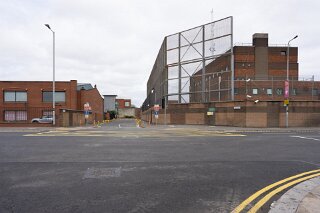
WHAT CAUGHT MY ATTENTION ON GROSVENOR ROAD WAS THE PSNI STATION SECURITY FENCE
The heavily fortified building with the high protective fencing on Grosvenor Road, situated across from the new Belfast Grand Central Station, is Grosvenor Road Police Station.
Key Facts About the Site:
The Station: It is an active PSNI (Police Service of Northern Ireland) station, formerly operated by the RUC (Royal Ulster Constabulary).
Military Connection: While it has never been an official British Army base, it functioned closely with the military during the Troubles. British Army foot and mobile patrols regularly co-located, deployed from, or supported RUC operations directly out of this station.
The Fortifications: The imposing, high-security steel mesh fencing and reinforced architecture are classic features of Troubles-era Belfast "peace walls" and fortified security outposts. These were designed to protect the police and co-operating military personnel from attacks.
Because of its strategic location right next to the massive new Weavers Cross and Grand Central Station transport development, it remains a highly visible—and heavily secured—landmark.
During the Troubles, Grosvenor Road RUC Station was far more than a local police precinct; it was one of the most strategically critical, heavily targeted, and highly fortified security installations in Northern Ireland.
Standing at the literal crossroads of segregated Belfast, its history reflects the division and violence that characterised West Belfast from 1969 until the Good Friday Agreement in 1998.
1. The Strategic Interface: Standing on the Divide
The station’s location was of immense tactical importance. It sat directly on the Grosvenor Road, a major arterial route connecting Belfast City Centre to West Belfast.
The Geography: To the north lay the staunchly nationalist/republican Falls Road and Divis areas. To the south lay loyalist enclaves like Sandy Row and Roden Street.
The Buffer: As the population shifted violently in late 1969, the Grosvenor Road area became a highly volatile sectarian interface. The station was situated directly at this flashpoint, acting as a physical buffer and a highly visible symbol of state authority right at the gateway to the republican West of the city.
2. Headquarters of the Volatile "B Division"
Under the RUC’s command structure, the Grosvenor Road station served as the headquarters for 'B' Division (West Belfast).
Area of Responsibility: This division oversaw some of the most active republican strongholds in Northern Ireland, including the Falls, Ballymurphy, Clonard, and Andersonstown.
Joint Military Hub: Because of the intensity of the conflict in West Belfast, the RUC could not patrol these areas alone. Grosvenor Road became a primary hub for joint operations. British Army infantry battalions (such as the Royal Anglian Regiment) were co-located with or operated in direct support of the police here, launching heavily armored mobile patrols and foot patrols straight from the station's reinforced gates.
3. A Prime Target for Paramilitary Attacks
Because of its role in directing security operations in West Belfast, the station and its immediate surroundings were a constant target for the Provisional IRA (particularly its notorious "D Company", Belfast Brigade).
Sgt. Tony Butcher (1972): One of the most tragic local incidents occurred when a massive PIRA car bomb was left near residential homes right by the station. British Army Bomb Disposal Officer Sgt. Tony Butcher was killed while attempting to defuse the device.
Rocket and Sniper Fire: The station and the checkpoint outside were frequently attacked using automatic weapons, sniper fire, and anti-tank rockets (RPGs) fired from nearby streets. In January 1992, an IRA unit fired a volley of shots, including tracer rounds, directly at the security checkpoint outside the base.
The Royal Victoria Hospital Conflict: The station also had to manage security for the nearby Royal Victoria Hospital. Because staff and security forces had to use the Grosvenor Road to access the hospital, this transport corridor was a frequent site of ambushes and roadside bombings.
4. Evolution into a Fortress
As the security threat escalated through the 1970s and 1980s, the physical architecture of the station changed dramatically:
Police Service of Northern Ireland
The original brick building was progressively encased in steel-mesh anti-rocket fencing designed to detonate incoming rocket-propelled grenades before they hit the main walls.
Bulletproof watchtowers (known as sangers) were constructed on the perimeter to give security forces an elevated view of the surrounding streets.
Heavily reinforced steel gates and vehicle airlocks were installed to prevent ram-raids and close-quarter "coffee jar" bomb attacks.
By the late 20th century, it resembled a military outpost more than a conventional police station, reflecting the high-risk reality of policing West Belfast.
The Post-Conflict Era
Following the 1998 Good Friday Agreement and the subsequent transition from the RUC to the PSNI, the operational environment changed. While many other Troubles-era stations across Northern Ireland were closed and demolished, Grosvenor Road remained active due to its strategic position on the edge of the city centre.
Though the watchtowers and some of the most aggressive military features have been scaled back, the high, protective steel fencing remains a lingering monument to Belfast's turbulent past.
Barracks Or Station
And now a fascinating bit of linguistic and social history! The difference in terminology between "Barracks" in Ireland (both North and South historically) and "Police Stations" in Great Britain is not an accident—it directly reflects the completely different ways the two islands were policed under British rule.
Why? The short answer is that the police in Great Britain were historically designed as unarmed civilians, whereas the police in Ireland were structured as an armed, semi-military garrison force.
1. The Root Cause: The Royal Irish Constabulary (RIC)
In 1829, Sir Robert Peel established the Metropolitan Police in London based on the "Peelarian principles" of policing by consent. These officers ("bobbies") were unarmed, lived in the local community with their families, and worked out of "Police Stations." They were civilians first and foremost.
Ireland was a very different story. Following the Act of Union, the British administration faced constant agrarian unrest, secret societies, and nationalist rebellions. To control the country, they established the Irish Constabulary (later the Royal Irish Constabulary or RIC) in 1836.
Unlike their British counterparts, the RIC was a quasi-military gendarmerie force:
Armed and Drilled: Constables were routinely armed with carbine rifles and pistols, drilled like soldiers, and subjected to military discipline.
No Local Ties: To prevent them from sympathising with the local population, men were strictly forbidden from serving in their native counties or marrying without permission.
Billeted in Barracks: Because they were effectively a peacekeeping garrison occupying potentially hostile territory, they could not go home to local families at night. Instead, they were "billeted" (housed) together in fortified, government-owned buildings. Naturally, these fortified, communal living quarters were called Barracks.
2. The Legacy in the Republic of Ireland (ROI)
When the Irish Free State was established in 1922, the RIC was disbanded and replaced by An Garda Síochána.
The new Irish government made a massive, deliberate symbolic statement by making the Gardaí an unarmed force, explicitly turning away from the militaristic style of the RIC.
However, old habits and physical infrastructure die hard:
The Buildings: The new Gardaí simply moved into the physical buildings left behind by the RIC (the ones that hadn't been burned down during the War of Independence).
The Terminology: Because generations of Irish people had spent a century walking past the local "RIC Barracks," the term "Garda Barracks" (or just "the barracks") naturally stuck. Even though the Gardaí were unarmed civil servants, the language of the physical space survived. To this day, while the official modern term is "Garda Station," older generations and people in rural areas across the Republic will still say, "I'm just heading down to the barracks."
3. What about Northern Ireland (NI)?
In Northern Ireland, the story took a different path. After partition in 1922, the Royal Ulster Constabulary (RUC) was formed as the successor to the RIC in the North.
The RUC Era: Unlike the Gardaí, the RUC remained a routinely armed, semi-military force to counter the threat of republican paramilitaries. Because they maintained the old RIC structures, their bases were officially and legally called RUC Barracks (e.g., Grosvenor Road RUC Barracks).
The PSNI Transition (2001): As a key part of the Peace Process and the Good Friday Agreement, the Patten Commission recommended sweeping reforms to policing to make it more community-focused. The RUC was replaced by the Police Service of Northern Ireland (PSNI).
Demilitarising the Language: Along with changing the uniforms and the badge, there was a deliberate, official effort to phase out militaristic terminology. The word "Barracks" was officially dropped in favour of "Police Station" to foster a more "civilian" image.
However, just like in the South, colloquial speech lingers. In Northern Ireland, depending on who you are talking to, you will still hear people refer to the local PSNI station as "the barracks"—a linguistic footprint of a long, shared, and heavily fortified history.
Key Facts About the Site:
The Station: It is an active PSNI (Police Service of Northern Ireland) station, formerly operated by the RUC (Royal Ulster Constabulary).
Military Connection: While it has never been an official British Army base, it functioned closely with the military during the Troubles. British Army foot and mobile patrols regularly co-located, deployed from, or supported RUC operations directly out of this station.
The Fortifications: The imposing, high-security steel mesh fencing and reinforced architecture are classic features of Troubles-era Belfast "peace walls" and fortified security outposts. These were designed to protect the police and co-operating military personnel from attacks.
Because of its strategic location right next to the massive new Weavers Cross and Grand Central Station transport development, it remains a highly visible—and heavily secured—landmark.
During the Troubles, Grosvenor Road RUC Station was far more than a local police precinct; it was one of the most strategically critical, heavily targeted, and highly fortified security installations in Northern Ireland.
Standing at the literal crossroads of segregated Belfast, its history reflects the division and violence that characterised West Belfast from 1969 until the Good Friday Agreement in 1998.
1. The Strategic Interface: Standing on the Divide
The station’s location was of immense tactical importance. It sat directly on the Grosvenor Road, a major arterial route connecting Belfast City Centre to West Belfast.
The Geography: To the north lay the staunchly nationalist/republican Falls Road and Divis areas. To the south lay loyalist enclaves like Sandy Row and Roden Street.
The Buffer: As the population shifted violently in late 1969, the Grosvenor Road area became a highly volatile sectarian interface. The station was situated directly at this flashpoint, acting as a physical buffer and a highly visible symbol of state authority right at the gateway to the republican West of the city.
2. Headquarters of the Volatile "B Division"
Under the RUC’s command structure, the Grosvenor Road station served as the headquarters for 'B' Division (West Belfast).
Area of Responsibility: This division oversaw some of the most active republican strongholds in Northern Ireland, including the Falls, Ballymurphy, Clonard, and Andersonstown.
Joint Military Hub: Because of the intensity of the conflict in West Belfast, the RUC could not patrol these areas alone. Grosvenor Road became a primary hub for joint operations. British Army infantry battalions (such as the Royal Anglian Regiment) were co-located with or operated in direct support of the police here, launching heavily armored mobile patrols and foot patrols straight from the station's reinforced gates.
3. A Prime Target for Paramilitary Attacks
Because of its role in directing security operations in West Belfast, the station and its immediate surroundings were a constant target for the Provisional IRA (particularly its notorious "D Company", Belfast Brigade).
Sgt. Tony Butcher (1972): One of the most tragic local incidents occurred when a massive PIRA car bomb was left near residential homes right by the station. British Army Bomb Disposal Officer Sgt. Tony Butcher was killed while attempting to defuse the device.
Rocket and Sniper Fire: The station and the checkpoint outside were frequently attacked using automatic weapons, sniper fire, and anti-tank rockets (RPGs) fired from nearby streets. In January 1992, an IRA unit fired a volley of shots, including tracer rounds, directly at the security checkpoint outside the base.
The Royal Victoria Hospital Conflict: The station also had to manage security for the nearby Royal Victoria Hospital. Because staff and security forces had to use the Grosvenor Road to access the hospital, this transport corridor was a frequent site of ambushes and roadside bombings.
4. Evolution into a Fortress
As the security threat escalated through the 1970s and 1980s, the physical architecture of the station changed dramatically:
Police Service of Northern Ireland
The original brick building was progressively encased in steel-mesh anti-rocket fencing designed to detonate incoming rocket-propelled grenades before they hit the main walls.
Bulletproof watchtowers (known as sangers) were constructed on the perimeter to give security forces an elevated view of the surrounding streets.
Heavily reinforced steel gates and vehicle airlocks were installed to prevent ram-raids and close-quarter "coffee jar" bomb attacks.
By the late 20th century, it resembled a military outpost more than a conventional police station, reflecting the high-risk reality of policing West Belfast.
The Post-Conflict Era
Following the 1998 Good Friday Agreement and the subsequent transition from the RUC to the PSNI, the operational environment changed. While many other Troubles-era stations across Northern Ireland were closed and demolished, Grosvenor Road remained active due to its strategic position on the edge of the city centre.
Though the watchtowers and some of the most aggressive military features have been scaled back, the high, protective steel fencing remains a lingering monument to Belfast's turbulent past.
Barracks Or Station
And now a fascinating bit of linguistic and social history! The difference in terminology between "Barracks" in Ireland (both North and South historically) and "Police Stations" in Great Britain is not an accident—it directly reflects the completely different ways the two islands were policed under British rule.
Why? The short answer is that the police in Great Britain were historically designed as unarmed civilians, whereas the police in Ireland were structured as an armed, semi-military garrison force.
1. The Root Cause: The Royal Irish Constabulary (RIC)
In 1829, Sir Robert Peel established the Metropolitan Police in London based on the "Peelarian principles" of policing by consent. These officers ("bobbies") were unarmed, lived in the local community with their families, and worked out of "Police Stations." They were civilians first and foremost.
Ireland was a very different story. Following the Act of Union, the British administration faced constant agrarian unrest, secret societies, and nationalist rebellions. To control the country, they established the Irish Constabulary (later the Royal Irish Constabulary or RIC) in 1836.
Unlike their British counterparts, the RIC was a quasi-military gendarmerie force:
Armed and Drilled: Constables were routinely armed with carbine rifles and pistols, drilled like soldiers, and subjected to military discipline.
No Local Ties: To prevent them from sympathising with the local population, men were strictly forbidden from serving in their native counties or marrying without permission.
Billeted in Barracks: Because they were effectively a peacekeeping garrison occupying potentially hostile territory, they could not go home to local families at night. Instead, they were "billeted" (housed) together in fortified, government-owned buildings. Naturally, these fortified, communal living quarters were called Barracks.
2. The Legacy in the Republic of Ireland (ROI)
When the Irish Free State was established in 1922, the RIC was disbanded and replaced by An Garda Síochána.
The new Irish government made a massive, deliberate symbolic statement by making the Gardaí an unarmed force, explicitly turning away from the militaristic style of the RIC.
However, old habits and physical infrastructure die hard:
The Buildings: The new Gardaí simply moved into the physical buildings left behind by the RIC (the ones that hadn't been burned down during the War of Independence).
The Terminology: Because generations of Irish people had spent a century walking past the local "RIC Barracks," the term "Garda Barracks" (or just "the barracks") naturally stuck. Even though the Gardaí were unarmed civil servants, the language of the physical space survived. To this day, while the official modern term is "Garda Station," older generations and people in rural areas across the Republic will still say, "I'm just heading down to the barracks."
3. What about Northern Ireland (NI)?
In Northern Ireland, the story took a different path. After partition in 1922, the Royal Ulster Constabulary (RUC) was formed as the successor to the RIC in the North.
The RUC Era: Unlike the Gardaí, the RUC remained a routinely armed, semi-military force to counter the threat of republican paramilitaries. Because they maintained the old RIC structures, their bases were officially and legally called RUC Barracks (e.g., Grosvenor Road RUC Barracks).
The PSNI Transition (2001): As a key part of the Peace Process and the Good Friday Agreement, the Patten Commission recommended sweeping reforms to policing to make it more community-focused. The RUC was replaced by the Police Service of Northern Ireland (PSNI).
Demilitarising the Language: Along with changing the uniforms and the badge, there was a deliberate, official effort to phase out militaristic terminology. The word "Barracks" was officially dropped in favour of "Police Station" to foster a more "civilian" image.
However, just like in the South, colloquial speech lingers. In Northern Ireland, depending on who you are talking to, you will still hear people refer to the local PSNI station as "the barracks"—a linguistic footprint of a long, shared, and heavily fortified history.
GROSVENOR ROAD