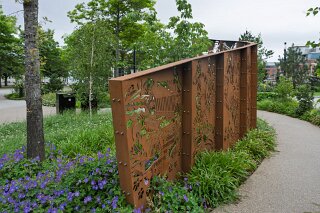
BELFAST CITY QUAYS GARDENS JULY 2026
MY JULY 2026 VISIT TO BELFAST CITY QUAYS GARDENS [I USED A SONY A7RVI WITH A 24MM F1.4 LENS]
An ambitious project on Belfast's historic waterfront, City Quays Gardens transforms what was once an underused surface car park into a vibrant, two-acre green haven. Officially opened in May 2025, the project stands as a benchmark for modern, eco-conscious landscape architecture in Ireland.
1. Original Concept & Environmental Standard
The project was envisioned by Belfast Harbour as the civic and ecological heart of its wider multi-million-pound City Quays masterplan. The primary intent was to bridge the gap between Belfast's urban core and the River Lagan, replacing harsh asphalt with a "maritime urban park" that celebrates the docklands' vast industrial past.
A core pillar of the concept was strict environmental accountability. City Quays Gardens was designed to meet the rigorous global "One Planet Living" sustainability framework. As the first public realm scheme in Northern Ireland to secure this prestigious accolade, its blueprint focused on climate resilience, promoting biodiversity, and creating spaces dedicated to physical and mental wellbeing.
2. Ownership & Governance: Is it a POPS?
Yes, technically City Quays Gardens falls under the definition of a Privately Owned Public Space (POPS), though its civic ethos behaves like a traditional municipal park.
Ownership & Funding: The site is owned, managed, and maintained entirely by Belfast Harbour (the Belfast Harbour Commissioners). It represents a £3.5 million direct investment by the port authority.
The Council's Role: While Belfast City Council does not own the land, they worked in close partnership with Belfast Harbour through their strategic "Bolder Vision" strategy. The council grants planning approvals and aligns the park’s targets with municipal goals for active travel, urban greening, and community integration.
3. Location & Spatial Design
The park occupies a highly prominent two-acre pocket of real estate in Corporation Square (BT1 3AL). It is geographically sandwiched between the historic, listed Belfast Harbour Office and the sleek, glass-clad commercial skyscrapers of City Quays 1, 2, and 3. This exact positioning creates a striking architectural dialogue between Belfast’s 19th-century maritime legacy and its modern 21st-century economic core.
4. Execution & Individual Design Elements
The park was masterfully designed by international landscape architects Gillespies, in partnership with graphic designers Smiling Wolf and engineering specialists, with delivery handled by contractor Northstone (NI) Limited. It features beautifully integrated, functional pockets:
The 'Gateway Nest': Guarding the entrance is a spectacular, softly illuminated structural pavilion made of concentric rings mimicking a giant bird's nest. It represents a visual metaphor for the return of nature to an industrial landscape.
Narrative Seating & Art Trail: Visitors can rest on bespoke, sculpted granite benches etched with stories charting the port's history from a 15th-century minor wharf to the industrial peak of Harland & Wolff. It features an interactive artwork trail and playful swinging seats.
The Central Compass Artwork: Crafted expertly out of premium Irish Kilkenny Blue limestone, bronze inlays, and Portuguese granite setts, a massive illustrative compass is set into the pavement, pointing the way toward major Belfast landmarks.
Sustainable Drainage & Eco-Zones: The park features 89 newly planted trees, wide events lawns with amphitheatre-style seating, and dedicated rain gardens. A smart irrigation network traps, filters, and recycles on-site surface water to keep the diverse flora hydrated.
Outdoor Workspaces: Reflecting modern, hybrid professional life, the park features specialized outdoor agile workspaces with seating layouts tailored for business professionals stepping out from adjacent City Quays Belfast
5. Active Travel & Integrated Bike Hire Station
Crucially, the development acts as a vital structural link for sustainable infrastructure. The public pathway adjacent to City Quays Gardens directly connects the city's waterfront to the National Cycle Network (Route 93) via a widened, off-road path.
To support this active travel corridor, a dedicated Belfast Bikes hire station and secure bicycle shelters were strategically relocated right onto the public path beside the park. This means commuters, tourists, and locals can seamlessly cycle up, dock their hire bike, and immediately step into the park's tranquil green surroundings.
6. Public & Civic
The public reception following its launch has been resoundingly positive. For years, Belfast's waterfront faced local criticism for being heavily dominated by concrete, car parking, and exclusive corporate spaces. The conversion of an asphalt car park into an eco-haven was hailed by urban planners as an "exemplar in creative placemaking."
Community groups and office workers alike have embraced the park as an essential urban breathing space. Civic leaders praised the space for successfully balancing commercial district needs with accessible, inclusive social spaces that honour Belfast's industrial soul.
And There Is Gold
Liquid Sunlight and Century-Old Craftsmanship: The Gilded Railings of Belfast’s City Quays
While exploring the sleek, glass-and-steel expanse of Belfast's regenerated waterfront at City Quays during the brilliant July 2026 heatwave, my camera eye was drawn away from the massive office blocks and down to the finer architectural details. Specifically, the high-quality decorative ironwork and railings surrounding the complex caught the midday light in a way that standard paint simply cannot replicate.
As I approached, I discovered why. A local decorative artist was meticulously working her way along the metalwork, applying what appeared to be liquid gold to the specific decorative accents. Intrigued by the rich depth of the material, I stopped for a chat.
What looked like high-end metallic paint was actually an ancient, highly disciplined craft: the application of genuine loose gold leaf. During our conversation, she made a striking statement that instantly reframed how I looked at the modern site: if applied properly, this micro-thin layer of precious metal would easily last for 100 years, if not longer.
Fact-Checking the Century-Long Claim
As a technical observer, a claim of a 100-year lifespan for an outdoor finish—especially in a damp, windy maritime climate like the Belfast docks—sounds almost like folklore. However, a deep dive into the science of traditional gilding reveals that the artist was remarkably accurate, though with a few environmental caveats.
Pure elemental gold (typically 23.75 or 24 karat leaf used for exterior work) is a noble metal. This means it is entirely inert; it does not oxidise, rust, tarnish, or react to atmospheric pollution or acid rain. Unlike standard commercial paints, gold is completely immune to ultraviolet radiation. The sun's rays will never cause it to fade, bleach, or lose its luster.
When gold leaf is applied indoors, it can easily last for centuries entirely unaltered. Outdoors, the gold itself remains immortal, but it relies on its foundation. Over decades, microscopic wind-borne grit, salt air, and physical friction will slowly abrade the micro-thin surface, and the underlying adhesive or ironwork can shift. Realistically, on an exposed public perimeter like the City Quays railings, a flawless lifespan of 30 to 50 years is the standard expectation, but well-sheltered architectural accents can push closer to that legendary 100-year mark before requiring a touch-up.
The Alchemy of the Process
Watching the gilding process up close highlights just how much patience and precision it demands. The artist cannot simply brush it on; gold leaf is beaten down until it is approximately 0.1 micrometres thick—roughly 400 times thinner than a human hair. At this thickness, touching the leaf with bare fingers would instantly disintegrate it into worthless dust due to natural skin oils.
Instead, the metalwork must first be prepared to a flawlessly smooth finish and coated with a specialised, oil-based varnish known as "gilding size". The artist must wait for this adhesive to dry down to a very specific level of tackiness—a brief operational window where it feels exactly like the sticky side of a note sheet.
Using a flat, wide brush made of soft squirrel hair, called a Gilder’s Tip, the artist gently rubs the brush against her cheek or hair. This action generates a tiny charge of static electricity, just enough to lift an individual square of gold leaf from its tissue book and float it onto the tacky ironwork. Once laid down, a soft cotton mop brush is used to gently press the metal into the adhesive and sweep away the overlapping fragments.
Why True Gold Outlasts "Gold Paint"
The distinction between what this artist was doing and standard property maintenance is night and day.
Standard metallic gold paints rely on copper, bronze, or mica flakes suspended in an acrylic or oil binder. Within three to seven years of outdoor exposure, UV light breaks down the clear binder, causing it to dull and chalk, while oxygen and moisture turn the copper particles a muddy green or dull grey. To combat this, paint requires heavy synthetic sealers, which eventually cloud and crack.
Genuine gold leaf, by contrast, requires no sealer at all. In fact, applying a clear coat over real gold ruins its unique refractive index, dulling its natural glow. Left bare to the elements, pure gold remains bright and pristine.
By investing in traditional hand-gilded accents for the perimeter railings, the designers of the City Quays complex have ensured a brilliant visual contrast. Long after the modern glass facades of the surrounding office buildings require deep structural refits, glass replacements, and heavy chemical cleaning, these micro-thin details will still be catching the Belfast sunlight with the exact same deep, radiant luster as the day they were laid down.
An ambitious project on Belfast's historic waterfront, City Quays Gardens transforms what was once an underused surface car park into a vibrant, two-acre green haven. Officially opened in May 2025, the project stands as a benchmark for modern, eco-conscious landscape architecture in Ireland.
1. Original Concept & Environmental Standard
The project was envisioned by Belfast Harbour as the civic and ecological heart of its wider multi-million-pound City Quays masterplan. The primary intent was to bridge the gap between Belfast's urban core and the River Lagan, replacing harsh asphalt with a "maritime urban park" that celebrates the docklands' vast industrial past.
A core pillar of the concept was strict environmental accountability. City Quays Gardens was designed to meet the rigorous global "One Planet Living" sustainability framework. As the first public realm scheme in Northern Ireland to secure this prestigious accolade, its blueprint focused on climate resilience, promoting biodiversity, and creating spaces dedicated to physical and mental wellbeing.
2. Ownership & Governance: Is it a POPS?
Yes, technically City Quays Gardens falls under the definition of a Privately Owned Public Space (POPS), though its civic ethos behaves like a traditional municipal park.
Ownership & Funding: The site is owned, managed, and maintained entirely by Belfast Harbour (the Belfast Harbour Commissioners). It represents a £3.5 million direct investment by the port authority.
The Council's Role: While Belfast City Council does not own the land, they worked in close partnership with Belfast Harbour through their strategic "Bolder Vision" strategy. The council grants planning approvals and aligns the park’s targets with municipal goals for active travel, urban greening, and community integration.
3. Location & Spatial Design
The park occupies a highly prominent two-acre pocket of real estate in Corporation Square (BT1 3AL). It is geographically sandwiched between the historic, listed Belfast Harbour Office and the sleek, glass-clad commercial skyscrapers of City Quays 1, 2, and 3. This exact positioning creates a striking architectural dialogue between Belfast’s 19th-century maritime legacy and its modern 21st-century economic core.
4. Execution & Individual Design Elements
The park was masterfully designed by international landscape architects Gillespies, in partnership with graphic designers Smiling Wolf and engineering specialists, with delivery handled by contractor Northstone (NI) Limited. It features beautifully integrated, functional pockets:
The 'Gateway Nest': Guarding the entrance is a spectacular, softly illuminated structural pavilion made of concentric rings mimicking a giant bird's nest. It represents a visual metaphor for the return of nature to an industrial landscape.
Narrative Seating & Art Trail: Visitors can rest on bespoke, sculpted granite benches etched with stories charting the port's history from a 15th-century minor wharf to the industrial peak of Harland & Wolff. It features an interactive artwork trail and playful swinging seats.
The Central Compass Artwork: Crafted expertly out of premium Irish Kilkenny Blue limestone, bronze inlays, and Portuguese granite setts, a massive illustrative compass is set into the pavement, pointing the way toward major Belfast landmarks.
Sustainable Drainage & Eco-Zones: The park features 89 newly planted trees, wide events lawns with amphitheatre-style seating, and dedicated rain gardens. A smart irrigation network traps, filters, and recycles on-site surface water to keep the diverse flora hydrated.
Outdoor Workspaces: Reflecting modern, hybrid professional life, the park features specialized outdoor agile workspaces with seating layouts tailored for business professionals stepping out from adjacent City Quays Belfast
5. Active Travel & Integrated Bike Hire Station
Crucially, the development acts as a vital structural link for sustainable infrastructure. The public pathway adjacent to City Quays Gardens directly connects the city's waterfront to the National Cycle Network (Route 93) via a widened, off-road path.
To support this active travel corridor, a dedicated Belfast Bikes hire station and secure bicycle shelters were strategically relocated right onto the public path beside the park. This means commuters, tourists, and locals can seamlessly cycle up, dock their hire bike, and immediately step into the park's tranquil green surroundings.
6. Public & Civic
The public reception following its launch has been resoundingly positive. For years, Belfast's waterfront faced local criticism for being heavily dominated by concrete, car parking, and exclusive corporate spaces. The conversion of an asphalt car park into an eco-haven was hailed by urban planners as an "exemplar in creative placemaking."
Community groups and office workers alike have embraced the park as an essential urban breathing space. Civic leaders praised the space for successfully balancing commercial district needs with accessible, inclusive social spaces that honour Belfast's industrial soul.
And There Is Gold
Liquid Sunlight and Century-Old Craftsmanship: The Gilded Railings of Belfast’s City Quays
While exploring the sleek, glass-and-steel expanse of Belfast's regenerated waterfront at City Quays during the brilliant July 2026 heatwave, my camera eye was drawn away from the massive office blocks and down to the finer architectural details. Specifically, the high-quality decorative ironwork and railings surrounding the complex caught the midday light in a way that standard paint simply cannot replicate.
As I approached, I discovered why. A local decorative artist was meticulously working her way along the metalwork, applying what appeared to be liquid gold to the specific decorative accents. Intrigued by the rich depth of the material, I stopped for a chat.
What looked like high-end metallic paint was actually an ancient, highly disciplined craft: the application of genuine loose gold leaf. During our conversation, she made a striking statement that instantly reframed how I looked at the modern site: if applied properly, this micro-thin layer of precious metal would easily last for 100 years, if not longer.
Fact-Checking the Century-Long Claim
As a technical observer, a claim of a 100-year lifespan for an outdoor finish—especially in a damp, windy maritime climate like the Belfast docks—sounds almost like folklore. However, a deep dive into the science of traditional gilding reveals that the artist was remarkably accurate, though with a few environmental caveats.
Pure elemental gold (typically 23.75 or 24 karat leaf used for exterior work) is a noble metal. This means it is entirely inert; it does not oxidise, rust, tarnish, or react to atmospheric pollution or acid rain. Unlike standard commercial paints, gold is completely immune to ultraviolet radiation. The sun's rays will never cause it to fade, bleach, or lose its luster.
When gold leaf is applied indoors, it can easily last for centuries entirely unaltered. Outdoors, the gold itself remains immortal, but it relies on its foundation. Over decades, microscopic wind-borne grit, salt air, and physical friction will slowly abrade the micro-thin surface, and the underlying adhesive or ironwork can shift. Realistically, on an exposed public perimeter like the City Quays railings, a flawless lifespan of 30 to 50 years is the standard expectation, but well-sheltered architectural accents can push closer to that legendary 100-year mark before requiring a touch-up.
The Alchemy of the Process
Watching the gilding process up close highlights just how much patience and precision it demands. The artist cannot simply brush it on; gold leaf is beaten down until it is approximately 0.1 micrometres thick—roughly 400 times thinner than a human hair. At this thickness, touching the leaf with bare fingers would instantly disintegrate it into worthless dust due to natural skin oils.
Instead, the metalwork must first be prepared to a flawlessly smooth finish and coated with a specialised, oil-based varnish known as "gilding size". The artist must wait for this adhesive to dry down to a very specific level of tackiness—a brief operational window where it feels exactly like the sticky side of a note sheet.
Using a flat, wide brush made of soft squirrel hair, called a Gilder’s Tip, the artist gently rubs the brush against her cheek or hair. This action generates a tiny charge of static electricity, just enough to lift an individual square of gold leaf from its tissue book and float it onto the tacky ironwork. Once laid down, a soft cotton mop brush is used to gently press the metal into the adhesive and sweep away the overlapping fragments.
Why True Gold Outlasts "Gold Paint"
The distinction between what this artist was doing and standard property maintenance is night and day.
Standard metallic gold paints rely on copper, bronze, or mica flakes suspended in an acrylic or oil binder. Within three to seven years of outdoor exposure, UV light breaks down the clear binder, causing it to dull and chalk, while oxygen and moisture turn the copper particles a muddy green or dull grey. To combat this, paint requires heavy synthetic sealers, which eventually cloud and crack.
Genuine gold leaf, by contrast, requires no sealer at all. In fact, applying a clear coat over real gold ruins its unique refractive index, dulling its natural glow. Left bare to the elements, pure gold remains bright and pristine.
By investing in traditional hand-gilded accents for the perimeter railings, the designers of the City Quays complex have ensured a brilliant visual contrast. Long after the modern glass facades of the surrounding office buildings require deep structural refits, glass replacements, and heavy chemical cleaning, these micro-thin details will still be catching the Belfast sunlight with the exact same deep, radiant luster as the day they were laid down.
BELFAST CITY QUAYS GARDENS