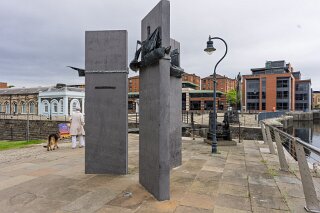
THE ECHOING BELOW SCULPTURE BY HOLGER LONZE
Echoing Below: Photographing Holger Lönze’s Maritime Vision in Belfast
Capturing public art is rarely a static experience, but few pieces have given me two such drastically different photographic encounters as Echoing Below.
When I first photographed this striking installation in December 2025, it was a battle against the elements. Caught in the teeth of a severe winter storm, the raw images were initially a wash of grey rain, requiring extensive post-processing rescue work. Because the site was so new at the time, uncovering the story behind the art felt like a piece of genuine investigative journalism.
Fast forward to July 2026. Returning to the site in the middle of a brilliant summer heatwave, I was armed with an upgraded setup: the ultra-high-resolution Sony A7RVI paired with the razor-sharp Sony FE 24mm f/1.4 GM lens. Bathed in harsh, direct sunlight rather than driving rain, the sculpture revealed an entirely different character, allowing me to fully appreciate the intricate textures that my first visit had masked.
The Vision Behind the Work
Installed in 2025 as the artistic centrepiece of the newly developed City Quays Gardens, Echoing Below is a three-piece public installation by German-born, West Cork-based sculptor Holger Lönze. Standing at 3.5 metres high, the work is a tactile marriage of Irish natural history and industrial heritage. Each piece features massive, structural slabs of prehistoric Valentia slate from County Kerry serving as anchors for intricate, hand-beaten repoussé bronze elements.
History Suspended in Time
The bronze, vessel-like forms rising from the slate bases are not mere abstractions. Lönze meticulously modeled them after three 19th-century paintings held in the private collection of the Belfast Harbour Commissioners, translating flat historic canvases back into three-dimensional space.
Each of the three segments charts a distinct era of development for the historic docks and the city. Walking through the installation, Lönze’s intent becomes clear: he wanted to create the physical sensation of "walking on the seabed". The 24mm focal length proved perfect here, allowing me to get close to the bases while capturing the dramatic way these bronze ghost-ships appear suspended in time and space against Belfast's modern waterfront.
Poetry, Slate, and the Changing City
During my stormy 2025 visit, the sheets of rain made the text elements difficult to decipher. In the clear light of summer, the accompanying verses can finally be read as they were intended. The installation features a beautifully integrated poem by the renowned Irish poet Paddy Bushe.
His lines explicitly invite observers to "Go below"—to attune their minds to the spectral echoes of the old shipyards. It asks us to listen for the ghost-sounds of creaking wooden hulls and the strain of heavy hemp ropes before we inevitably "step ashore" to return to the bustle of the modern city.
Beyond the Frame: Documenting Belfast's Living Canvas
As a street photographer, my instinct is usually to frame out bystanders and pets, seeking a clean, uninterrupted shot of the architecture or sculpture. However, during this blazing July session at City Quays Gardens, I made a deliberate choice to break my own rule. I left the people, and more specifically their dogs, inside the frame.
To sit by Lönze’s sculpture in 2026 is to witness a profound social phenomenon: a rapidly accelerating dog culture that is redefining Belfast's public spaces. While this surge in pet ownership is partly a global legacy of the pandemic era, in Belfast, it carries a deeper, distinctly post-conflict significance.
Reclaiming the Civic Realm: During the Troubles, the city's waterfront, interface areas, and public parks were frequently contested, heavily policed, or associated with risk. Today, walking a dog through a green space like City Quays Gardens represents a visible, peaceful reclamation of shared civic ground.
The Ultimate Apolitical Bridge: In a city historically divided by political or religious identity, a dog serves as a universal social lubricant. It acts as a neutral, apolitical bridge; people who might otherwise remain guarded across community lines will readily stop to swap stories about breeds, instantly forming a micro-community based purely on shared affection for an animal.
Urban Healing and Normalisation: Decades ago, these docks were closed off, industrial, and bleak. The deliberate transition from a former car park into a biodiverse, walkable public haven is a hallmark of Belfast's modern regeneration drive.
By leaving these dogs and their owners in the composition, the photographs capture a brilliant contrast. Lönze’s sculpture beautifully commands us to remember the heavy, industrial ghost-sounds of Belfast's past, but the active, canine-led life swirling around the slate bases provides the ultimate proof of its peaceful, living present.
Capturing public art is rarely a static experience, but few pieces have given me two such drastically different photographic encounters as Echoing Below.
When I first photographed this striking installation in December 2025, it was a battle against the elements. Caught in the teeth of a severe winter storm, the raw images were initially a wash of grey rain, requiring extensive post-processing rescue work. Because the site was so new at the time, uncovering the story behind the art felt like a piece of genuine investigative journalism.
Fast forward to July 2026. Returning to the site in the middle of a brilliant summer heatwave, I was armed with an upgraded setup: the ultra-high-resolution Sony A7RVI paired with the razor-sharp Sony FE 24mm f/1.4 GM lens. Bathed in harsh, direct sunlight rather than driving rain, the sculpture revealed an entirely different character, allowing me to fully appreciate the intricate textures that my first visit had masked.
The Vision Behind the Work
Installed in 2025 as the artistic centrepiece of the newly developed City Quays Gardens, Echoing Below is a three-piece public installation by German-born, West Cork-based sculptor Holger Lönze. Standing at 3.5 metres high, the work is a tactile marriage of Irish natural history and industrial heritage. Each piece features massive, structural slabs of prehistoric Valentia slate from County Kerry serving as anchors for intricate, hand-beaten repoussé bronze elements.
History Suspended in Time
The bronze, vessel-like forms rising from the slate bases are not mere abstractions. Lönze meticulously modeled them after three 19th-century paintings held in the private collection of the Belfast Harbour Commissioners, translating flat historic canvases back into three-dimensional space.
Each of the three segments charts a distinct era of development for the historic docks and the city. Walking through the installation, Lönze’s intent becomes clear: he wanted to create the physical sensation of "walking on the seabed". The 24mm focal length proved perfect here, allowing me to get close to the bases while capturing the dramatic way these bronze ghost-ships appear suspended in time and space against Belfast's modern waterfront.
Poetry, Slate, and the Changing City
During my stormy 2025 visit, the sheets of rain made the text elements difficult to decipher. In the clear light of summer, the accompanying verses can finally be read as they were intended. The installation features a beautifully integrated poem by the renowned Irish poet Paddy Bushe.
His lines explicitly invite observers to "Go below"—to attune their minds to the spectral echoes of the old shipyards. It asks us to listen for the ghost-sounds of creaking wooden hulls and the strain of heavy hemp ropes before we inevitably "step ashore" to return to the bustle of the modern city.
Beyond the Frame: Documenting Belfast's Living Canvas
As a street photographer, my instinct is usually to frame out bystanders and pets, seeking a clean, uninterrupted shot of the architecture or sculpture. However, during this blazing July session at City Quays Gardens, I made a deliberate choice to break my own rule. I left the people, and more specifically their dogs, inside the frame.
To sit by Lönze’s sculpture in 2026 is to witness a profound social phenomenon: a rapidly accelerating dog culture that is redefining Belfast's public spaces. While this surge in pet ownership is partly a global legacy of the pandemic era, in Belfast, it carries a deeper, distinctly post-conflict significance.
Reclaiming the Civic Realm: During the Troubles, the city's waterfront, interface areas, and public parks were frequently contested, heavily policed, or associated with risk. Today, walking a dog through a green space like City Quays Gardens represents a visible, peaceful reclamation of shared civic ground.
The Ultimate Apolitical Bridge: In a city historically divided by political or religious identity, a dog serves as a universal social lubricant. It acts as a neutral, apolitical bridge; people who might otherwise remain guarded across community lines will readily stop to swap stories about breeds, instantly forming a micro-community based purely on shared affection for an animal.
Urban Healing and Normalisation: Decades ago, these docks were closed off, industrial, and bleak. The deliberate transition from a former car park into a biodiverse, walkable public haven is a hallmark of Belfast's modern regeneration drive.
By leaving these dogs and their owners in the composition, the photographs capture a brilliant contrast. Lönze’s sculpture beautifully commands us to remember the heavy, industrial ghost-sounds of Belfast's past, but the active, canine-led life swirling around the slate bases provides the ultimate proof of its peaceful, living present.
THE ECHOING BELOW SCULPTURE