THIS WAS AN EXPERIMENT
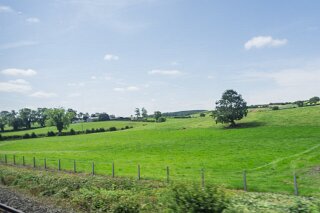
VIEWS FROM THE ENTERPRISE EXPRESS TRAIN - POYNTZPASS TO MULLAGLASS [I USED A SONY A7RVI WITH A 28-70 LENS]
Poyntzpass to Mullaglass: A Railway Journey
The rail journey from Poyntzpass to Mullaglass covers roughly eight miles of the historic Dublin–Belfast main line. Looking out from a carriage window along this section, the train transitions from a historic canal-border settlement through rolling, drumlin-dominated rural pastures, before approaching the northern engineering gate of Newry. This specific segment offers a dense sequence of industrial heritage and distinct topographical shifts.
Poyntzpass: The Border Pass
The visual sequence begins as the train sweeps past the village of Poyntzpass, which sits on the border of Counties Armagh and Down. The unique name stems from Lieutenant Charles Poyntz of the English army, who secured this critical military "pass" through the surrounding wetlands against Hugh O'Neill, Earl of Tyrone, in 1598.
This area is structurally defined by parallel paths of industrial transport history. The railway runs directly alongside the Newry Canal—opened in 1742 as the first summit-level canal in the British Isles. The stone lock keepers' houses, old towpaths, and quiet waters provide clean, linear foreground elements against the rolling hills, making it a compelling subject for high-speed transit documentation.
The Mid-Section: The Drumlins of Upper Orior
Moving south towards Mullaglass, the Enterprise Express cuts directly through the heart of the Upper Orior barony. This landscape is a textbook example of drumlin topography—low, oval-shaped hills formed by moving glacial ice sheets during the last Ice Age.
From a moving train, the sweeping curves of these small hills create a dynamic parallax effect against the background. The fields are heavily fragmented by ancient hedgerows, dotted with whitewashed vernacular stone farmsteads, and punctuated by the occasional disused brick or stone road bridge passing overhead. The route also passes near the remnants of Goraghwood, once a bustling, complex railway junction connecting lines to Armagh and Warrenpoint, but now reduced to a quiet, deep stone cutting.
Mullaglass: The Approach to the Viaduct
This journey section concludes at the townland of Mullaglass (spelt Mullaghglass on historical surveys, from the Irish Mullach Glas, meaning "the green hilltop"). Situated just north-west of Newry, this townland marks the transition where the train prepares to cross the massive valley floor.
Historically, Mullaglass hosted a brief, temporary passenger platform on the Armagh Road in the 1850s during early rail developments. Today, it serves as the dramatic visual crescendo for this photographic chapter. As the train leaves the Mullaglass cutting, the ground drops away completely, leading directly onto the breathtaking Craigmore Viaduct. Constructed from local granite, its 18 monumental arches span the valley, providing an elevated, panoramic sweep over the landscape towards Bessbrook.
Shooting Through the Glass: How the Sony A7R VI and 28-70mm GM Redeemed Train Photography
In the past, I have never been able to obtain acceptable image quality when photographing through the window of a train. Reflection, motion blur, and window grime usually combine to ruin the shot. However, today, while returning on the Enterprise from Belfast to Dublin, I decided to see if a high-end setup could change my luck.
I tested out the Sony A7R VI combined with the Sony FE 28-70mm f/2.0 GM lens, and the resulting images were far better than I was expecting. Thanks to the camera's incredible resolution and advanced stabilisation, paired with the pin-sharp optics and wide aperture of the GM lens, the glass elements virtually disappeared. The journey proved that with the right gear, train window photography isn't just possible—it can yield stunning results.
Poyntzpass to Mullaglass: A Railway Journey
The rail journey from Poyntzpass to Mullaglass covers roughly eight miles of the historic Dublin–Belfast main line. Looking out from a carriage window along this section, the train transitions from a historic canal-border settlement through rolling, drumlin-dominated rural pastures, before approaching the northern engineering gate of Newry. This specific segment offers a dense sequence of industrial heritage and distinct topographical shifts.
Poyntzpass: The Border Pass
The visual sequence begins as the train sweeps past the village of Poyntzpass, which sits on the border of Counties Armagh and Down. The unique name stems from Lieutenant Charles Poyntz of the English army, who secured this critical military "pass" through the surrounding wetlands against Hugh O'Neill, Earl of Tyrone, in 1598.
This area is structurally defined by parallel paths of industrial transport history. The railway runs directly alongside the Newry Canal—opened in 1742 as the first summit-level canal in the British Isles. The stone lock keepers' houses, old towpaths, and quiet waters provide clean, linear foreground elements against the rolling hills, making it a compelling subject for high-speed transit documentation.
The Mid-Section: The Drumlins of Upper Orior
Moving south towards Mullaglass, the Enterprise Express cuts directly through the heart of the Upper Orior barony. This landscape is a textbook example of drumlin topography—low, oval-shaped hills formed by moving glacial ice sheets during the last Ice Age.
From a moving train, the sweeping curves of these small hills create a dynamic parallax effect against the background. The fields are heavily fragmented by ancient hedgerows, dotted with whitewashed vernacular stone farmsteads, and punctuated by the occasional disused brick or stone road bridge passing overhead. The route also passes near the remnants of Goraghwood, once a bustling, complex railway junction connecting lines to Armagh and Warrenpoint, but now reduced to a quiet, deep stone cutting.
Mullaglass: The Approach to the Viaduct
This journey section concludes at the townland of Mullaglass (spelt Mullaghglass on historical surveys, from the Irish Mullach Glas, meaning "the green hilltop"). Situated just north-west of Newry, this townland marks the transition where the train prepares to cross the massive valley floor.
Historically, Mullaglass hosted a brief, temporary passenger platform on the Armagh Road in the 1850s during early rail developments. Today, it serves as the dramatic visual crescendo for this photographic chapter. As the train leaves the Mullaglass cutting, the ground drops away completely, leading directly onto the breathtaking Craigmore Viaduct. Constructed from local granite, its 18 monumental arches span the valley, providing an elevated, panoramic sweep over the landscape towards Bessbrook.
Shooting Through the Glass: How the Sony A7R VI and 28-70mm GM Redeemed Train Photography
In the past, I have never been able to obtain acceptable image quality when photographing through the window of a train. Reflection, motion blur, and window grime usually combine to ruin the shot. However, today, while returning on the Enterprise from Belfast to Dublin, I decided to see if a high-end setup could change my luck.
I tested out the Sony A7R VI combined with the Sony FE 28-70mm f/2.0 GM lens, and the resulting images were far better than I was expecting. Thanks to the camera's incredible resolution and advanced stabilisation, paired with the pin-sharp optics and wide aperture of the GM lens, the glass elements virtually disappeared. The journey proved that with the right gear, train window photography isn't just possible—it can yield stunning results.
POYNTZPASS TO MULLAGLASS