THE ILLUSION OF METAL CREATED BY THE HERDMAN MONUMENT
The Illusion of Metal: The Herdman Monument, Belfast
When first encountering this striking monument, many are convinced they are looking at a cast metal structure. In reality, it contains neither brass nor bronze.
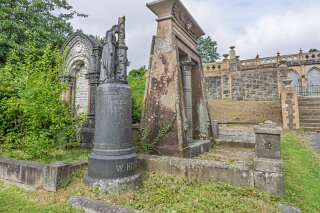
The monument is built entirely of stone, masterfully juxtaposing raw and polished materials. Its main body is carved from sandstone, which has acquired a rich reddish-brown hue and a weathered texture adorned with patches of wild moss and lichen. In striking contrast, the central column recessed within the alcove is made of polished grey granite, topped with an intricately carved stone capital.
Located in Belfast City Cemetery, this is the prominent Herdman Monument. Constructed between 1860 and 1879, it stands as a magnificent example of Victorian Egyptian Revivalist funerary architecture. The structure features a heavily tapered pylon shape, a winged sun-disc motif sweeping across the cornice, and a single central column—hallmarks of an era fascinated by ancient Egypt. The monument also features subtle, intriguing motifs widely believed to be Masonic in origin.
What Happened to the Herdman Family?
The monument commemorates Alexander Herdman, a member of a powerhouse industrial dynasty, who tragically died at the young age of 34.
The Flax Empire: Originally from Belfast, the Herdman family achieved immense wealth after brothers James, John, and George established a massive flax-spinning mill in 1835 at Sion Mills, County Tyrone. Influenced by social reformers, they built a famous "model village" for their workers, complete with schools, churches, and a strong cricket-playing tradition. At its peak, the mill employed over 1,500 people.
The Maritime Legacy: The family maintained deeply influential civic roles in Belfast, notably through the Belfast Harbour Board. Sir Ernest Herdman (1856–1952), a prominent member of the family, served as Chairman of the Harbour Commissioners. Under his leadership in the late 1920s and early 1930s, major new deep-water shipping channels were dredged in Belfast Lough. The deep-water channel was officially named the Herdman Channel in his honour.
The Decline: Like many titan families of the British industrial era, their fortunes eventually shifted. Cheap foreign competition from the late 20th century onwards heavily impacted the European linen trade. After 170 years of continuous operation, Herdmans Ltd closed down its Sion Mills production for good in 2004. Sion House, the grand 50-room Elizabethan Revival family estate built in the 1840s, was sold off in 1966, and its historic contents were auctioned away.
Today, while the physical mills are silent and the family's direct industrial reign has ended, their name is permanently etched into Belfast's landscape through both the shipping channels of the lough and this enigmatic sandstone pylon in the city cemetery.
When first encountering this striking monument, many are convinced they are looking at a cast metal structure. In reality, it contains neither brass nor bronze.
The monument is built entirely of stone, masterfully juxtaposing raw and polished materials. Its main body is carved from sandstone, which has acquired a rich reddish-brown hue and a weathered texture adorned with patches of wild moss and lichen. In striking contrast, the central column recessed within the alcove is made of polished grey granite, topped with an intricately carved stone capital.
Located in Belfast City Cemetery, this is the prominent Herdman Monument. Constructed between 1860 and 1879, it stands as a magnificent example of Victorian Egyptian Revivalist funerary architecture. The structure features a heavily tapered pylon shape, a winged sun-disc motif sweeping across the cornice, and a single central column—hallmarks of an era fascinated by ancient Egypt. The monument also features subtle, intriguing motifs widely believed to be Masonic in origin.
What Happened to the Herdman Family?
The monument commemorates Alexander Herdman, a member of a powerhouse industrial dynasty, who tragically died at the young age of 34.
The Flax Empire: Originally from Belfast, the Herdman family achieved immense wealth after brothers James, John, and George established a massive flax-spinning mill in 1835 at Sion Mills, County Tyrone. Influenced by social reformers, they built a famous "model village" for their workers, complete with schools, churches, and a strong cricket-playing tradition. At its peak, the mill employed over 1,500 people.
The Maritime Legacy: The family maintained deeply influential civic roles in Belfast, notably through the Belfast Harbour Board. Sir Ernest Herdman (1856–1952), a prominent member of the family, served as Chairman of the Harbour Commissioners. Under his leadership in the late 1920s and early 1930s, major new deep-water shipping channels were dredged in Belfast Lough. The deep-water channel was officially named the Herdman Channel in his honour.
The Decline: Like many titan families of the British industrial era, their fortunes eventually shifted. Cheap foreign competition from the late 20th century onwards heavily impacted the European linen trade. After 170 years of continuous operation, Herdmans Ltd closed down its Sion Mills production for good in 2004. Sion House, the grand 50-room Elizabethan Revival family estate built in the 1840s, was sold off in 1966, and its historic contents were auctioned away.
Today, while the physical mills are silent and the family's direct industrial reign has ended, their name is permanently etched into Belfast's landscape through both the shipping channels of the lough and this enigmatic sandstone pylon in the city cemetery.
THE HERDMAN MONUMENT