I USED AN ULTRA-WIDE ANGLE LENS
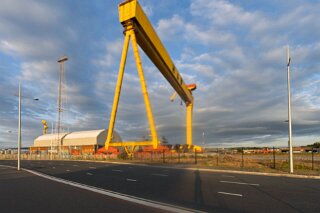
WIDE-ANGLE VIEWS OF THE BELFAST GANTRY CRANES AND BELLS THEOREM CRESCENT [I USED A 15MM VOIGTLANDER LENS]
The Belfast shipyards present a fascinating paradox. To stand beneath the gaze of the Harland & Wolff gantry cranes, Samson and Goliath, is to feel both incredibly close to and entirely detached from these industrial monuments.
While visiting the Titanic Quarter, I set out to capture these yellow titans using a Voigtlander 15mm ultra-wide-angle lens. However, translating the scale of these 100-metre-tall structures onto a camera sensor proved to be an unexpected lesson in spatial geometry, local history, and urban navigation.
The Scale Illusion and Bell's Theorem Crescent
The sheer scale of the shipyards plays tricks on your eyes. Because the cranes are so colossal, they appear within arm's reach when viewed across the flat expanse of the docks, but the actual distances are vast.
My initial attempt to close the distance led me down a loop named Bell's Theorem Crescent.
What's in a Name?
Skirting the Belfast Metropolitan College, this road is named after the Belfast-born physicist John Stewart Bell. His groundbreaking 1964 "Bell's Theorem" mathematically proved quantum entanglement—the idea that subatomic particles remain connected across vast distances. Because Belfast City Council has a policy against naming streets after specific people, they compromised on naming it after his famous mathematical concept. It is arguably the only street in the world named after a quantum physics theorem.
As fitting as "action at a distance" was for my photography attempt, the crescent proved to be a closed loop that deposited me back onto Queen's Road, leaving me no closer to my giant subjects. Under an ultra-wide 15mm lens, the distant cranes shrank into insignificance, swallowed up by a vast foreground of empty sky and asphalt.
The Enigma of Hamilton Road
Later that evening, determined to find a better vantage point, I took the Glider G2 bus back to the harbour. Alighting a stop early to explore Sydenham Road, I stumbled upon Hamilton Road. Having previously walked the length of Queens Road, I was astonished that I had missed this junction before.
Hamilton Road cuts through the raw, unpolished core of the historic shipyards. Today, its status is deeply confusing:
The Signage: The road was heavily guarded by imposing "Road Closed" signs and civil works, giving it the distinct, unwelcoming appearance of a private industrial thoroughfare.
The Reality: Local vehicles continued to carefully navigate the barriers toward Queens Road.
Hesitant to proceed but lured by the composition, I used this half-abandoned environment to frame the cranes.
Wide-Angle vs. Compression
While Hamilton Road sits directly in the shadow of the structural works—providing an incredibly raw, dramatic perspective—the ultra-wide 15mm Voigtlander was the wrong tool for the job. Ultra-wide lenses expand perspective, making distant objects look even smaller.
To properly capture the overwhelming weight of the cranes without the tourist-centric sanitisation of the Titanic Belfast museum lawns, a longer focal length is required. I left the docklands that evening knowing I would need to return later in the week with a 28-70mm zoom lens to compress the distance and give Samson and Goliath the visual dominance they deserve.
The Voigtländer 15mm f/4.5 Super Wide-Heliar Aspherical III is a legendary, ultra-compact manual prime lens that holds a unique position in the world of wide-angle photography. Originally designed for rangefinders, Voigtländer’s native Sony E-mount version is optically optimised for modern mirrorless digital sensors.
When paired with a high-resolution powerhouse like the Sony A7R VI (61 Megapixels), it becomes a specialized tool that offers distinct advantages—and a few challenges—for street, architectural, and landscape photographers.
Technical Features of the Voigtländer 15mm E-Mount
Unlike using adapted rangefinder lenses, the native E-mount version of the Super Wide-Heliar III is built to communicate flawlessly with modern Sony bodies:
Electronic Communication: The lens features built-in electronic contacts. This allows it to transmit full EXIF data to your camera, automatically trigger the camera's focus magnification (MF Assist) when you turn the focus ring, and enable in-camera lens corrections.
In-Body Image Stabilization (IBIS): Because the lens communicates its exact 15mm focal length to the camera, the A7R VI can precisely calibrate its 5-axis sensor stabilization, allowing you to easily shoot sharp images handheld in low-light conditions.
Optical Excellence: It utilizes an 11-element in 9-group optical formula, featuring one aspherical element. This design drastically minimizes the dramatic corner color-shifting and severe vignetting that plagued older manual wide-angle lenses on digital sensors.
Mechanical Perfection: True to Voigtländer’s heritage, the lens has a robust, all-metal barrel with a beautifully dampened focus ring. It also features the Selective Aperture Control System, letting you switch between a clicked aperture (in 1/3 stops) for photography and a de-clicked, silent aperture for video.
Threaded Filters: Despite its ultra-wide 110-degree field of view, the lens manages to include a 58mm front filter thread on its integrated hood. This is exceptionally rare for lenses this wide, allowing you to screw on circular polarisers or ND filters directly without relying on bulky, third-party square filter rigs.
Why Pair This Lens with the Sony A7R VI?
Putting a small, manual f/4.5 lens on a premium, high-resolution body might seem unusual at first, but the pairing creates a brilliant creative workflow:
1. The Ultimate "Zone Focusing" Walk-Around Set
At a 15mm focal length, depth of field is incredibly deep. When stopped down to f/8 or f/11, the hyperfocal distance of this lens is so forgiving that nearly everything from about a metre to infinity is in sharp focus. For fast-moving street photography, this completely eliminates the need to focus. You can leave the camera in manual focus, set your focus distance, and fire immediately—meaning zero autofocus lag and no missed moments.
2. High-Resolution Cropping Power
An ultra-wide 15mm lens can occasionally push your primary subject too far into the background, leaving the frame dominated by empty sky or pavement.
The 61-megapixel sensor of the A7R VI acts as a safety net. Because you have such an immense density of pixels, you can aggressively crop your files in Lightroom Classic and still retain a high-resolution, tack-sharp 24MP or 30MP image. Essentially, it transforms your 15mm prime into a virtual zoom, allowing you to recompose your shots after the fact without sacrificing image quality.
3. Crisp, Zero-Distortion Architecture
When combined with the A7R VI’s sensor, the Voigtländer III delivers outstanding sharpness across the entire frame, maintaining clarity right into the corners. For architectural shooters, the lens's control over geometric distortion is remarkable. When kept perfectly level, lines remain incredibly straight, making it a highly portable option for capturing interior spaces or narrow, historic city streets.
Practical Considerations and Limitations
The f/4.5 Aperture: This is a relatively slow lens. It is not designed for shallow-depth-of-field portraits or isolating subjects from the background.
Manual Only: There is no autofocus motor. If you are capturing fast-moving subjects close up, you will need to rely on zone focusing or focus peaking.
Perspective Distortion: Like all rectilinear ultra-wide lenses, anything placed near the very edges of the frame will stretch dramatically. Keeping the camera level is critical to preventing vertical lines from converging or "leaning" backward.
The Belfast shipyards present a fascinating paradox. To stand beneath the gaze of the Harland & Wolff gantry cranes, Samson and Goliath, is to feel both incredibly close to and entirely detached from these industrial monuments.
While visiting the Titanic Quarter, I set out to capture these yellow titans using a Voigtlander 15mm ultra-wide-angle lens. However, translating the scale of these 100-metre-tall structures onto a camera sensor proved to be an unexpected lesson in spatial geometry, local history, and urban navigation.
The Scale Illusion and Bell's Theorem Crescent
The sheer scale of the shipyards plays tricks on your eyes. Because the cranes are so colossal, they appear within arm's reach when viewed across the flat expanse of the docks, but the actual distances are vast.
My initial attempt to close the distance led me down a loop named Bell's Theorem Crescent.
What's in a Name?
Skirting the Belfast Metropolitan College, this road is named after the Belfast-born physicist John Stewart Bell. His groundbreaking 1964 "Bell's Theorem" mathematically proved quantum entanglement—the idea that subatomic particles remain connected across vast distances. Because Belfast City Council has a policy against naming streets after specific people, they compromised on naming it after his famous mathematical concept. It is arguably the only street in the world named after a quantum physics theorem.
As fitting as "action at a distance" was for my photography attempt, the crescent proved to be a closed loop that deposited me back onto Queen's Road, leaving me no closer to my giant subjects. Under an ultra-wide 15mm lens, the distant cranes shrank into insignificance, swallowed up by a vast foreground of empty sky and asphalt.
The Enigma of Hamilton Road
Later that evening, determined to find a better vantage point, I took the Glider G2 bus back to the harbour. Alighting a stop early to explore Sydenham Road, I stumbled upon Hamilton Road. Having previously walked the length of Queens Road, I was astonished that I had missed this junction before.
Hamilton Road cuts through the raw, unpolished core of the historic shipyards. Today, its status is deeply confusing:
The Signage: The road was heavily guarded by imposing "Road Closed" signs and civil works, giving it the distinct, unwelcoming appearance of a private industrial thoroughfare.
The Reality: Local vehicles continued to carefully navigate the barriers toward Queens Road.
Hesitant to proceed but lured by the composition, I used this half-abandoned environment to frame the cranes.
Wide-Angle vs. Compression
While Hamilton Road sits directly in the shadow of the structural works—providing an incredibly raw, dramatic perspective—the ultra-wide 15mm Voigtlander was the wrong tool for the job. Ultra-wide lenses expand perspective, making distant objects look even smaller.
To properly capture the overwhelming weight of the cranes without the tourist-centric sanitisation of the Titanic Belfast museum lawns, a longer focal length is required. I left the docklands that evening knowing I would need to return later in the week with a 28-70mm zoom lens to compress the distance and give Samson and Goliath the visual dominance they deserve.
The Voigtländer 15mm f/4.5 Super Wide-Heliar Aspherical III is a legendary, ultra-compact manual prime lens that holds a unique position in the world of wide-angle photography. Originally designed for rangefinders, Voigtländer’s native Sony E-mount version is optically optimised for modern mirrorless digital sensors.
When paired with a high-resolution powerhouse like the Sony A7R VI (61 Megapixels), it becomes a specialized tool that offers distinct advantages—and a few challenges—for street, architectural, and landscape photographers.
Technical Features of the Voigtländer 15mm E-Mount
Unlike using adapted rangefinder lenses, the native E-mount version of the Super Wide-Heliar III is built to communicate flawlessly with modern Sony bodies:
Electronic Communication: The lens features built-in electronic contacts. This allows it to transmit full EXIF data to your camera, automatically trigger the camera's focus magnification (MF Assist) when you turn the focus ring, and enable in-camera lens corrections.
In-Body Image Stabilization (IBIS): Because the lens communicates its exact 15mm focal length to the camera, the A7R VI can precisely calibrate its 5-axis sensor stabilization, allowing you to easily shoot sharp images handheld in low-light conditions.
Optical Excellence: It utilizes an 11-element in 9-group optical formula, featuring one aspherical element. This design drastically minimizes the dramatic corner color-shifting and severe vignetting that plagued older manual wide-angle lenses on digital sensors.
Mechanical Perfection: True to Voigtländer’s heritage, the lens has a robust, all-metal barrel with a beautifully dampened focus ring. It also features the Selective Aperture Control System, letting you switch between a clicked aperture (in 1/3 stops) for photography and a de-clicked, silent aperture for video.
Threaded Filters: Despite its ultra-wide 110-degree field of view, the lens manages to include a 58mm front filter thread on its integrated hood. This is exceptionally rare for lenses this wide, allowing you to screw on circular polarisers or ND filters directly without relying on bulky, third-party square filter rigs.
Why Pair This Lens with the Sony A7R VI?
Putting a small, manual f/4.5 lens on a premium, high-resolution body might seem unusual at first, but the pairing creates a brilliant creative workflow:
1. The Ultimate "Zone Focusing" Walk-Around Set
At a 15mm focal length, depth of field is incredibly deep. When stopped down to f/8 or f/11, the hyperfocal distance of this lens is so forgiving that nearly everything from about a metre to infinity is in sharp focus. For fast-moving street photography, this completely eliminates the need to focus. You can leave the camera in manual focus, set your focus distance, and fire immediately—meaning zero autofocus lag and no missed moments.
2. High-Resolution Cropping Power
An ultra-wide 15mm lens can occasionally push your primary subject too far into the background, leaving the frame dominated by empty sky or pavement.
The 61-megapixel sensor of the A7R VI acts as a safety net. Because you have such an immense density of pixels, you can aggressively crop your files in Lightroom Classic and still retain a high-resolution, tack-sharp 24MP or 30MP image. Essentially, it transforms your 15mm prime into a virtual zoom, allowing you to recompose your shots after the fact without sacrificing image quality.
3. Crisp, Zero-Distortion Architecture
When combined with the A7R VI’s sensor, the Voigtländer III delivers outstanding sharpness across the entire frame, maintaining clarity right into the corners. For architectural shooters, the lens's control over geometric distortion is remarkable. When kept perfectly level, lines remain incredibly straight, making it a highly portable option for capturing interior spaces or narrow, historic city streets.
Practical Considerations and Limitations
The f/4.5 Aperture: This is a relatively slow lens. It is not designed for shallow-depth-of-field portraits or isolating subjects from the background.
Manual Only: There is no autofocus motor. If you are capturing fast-moving subjects close up, you will need to rely on zone focusing or focus peaking.
Perspective Distortion: Like all rectilinear ultra-wide lenses, anything placed near the very edges of the frame will stretch dramatically. Keeping the camera level is critical to preventing vertical lines from converging or "leaning" backward.
BIG YELLOW GANTRY CRANES