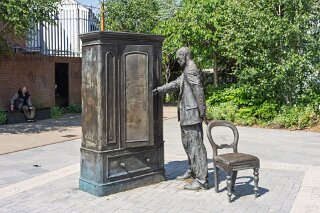
I USED A VOIGTLANDER 40MM LENS FOR THIS SESSION
THE SEARCHER AT CS LEWIS SQUARE BY MAURICE HARRON [THE LION THE WITCH AND THE WARDROBE]
The public square dedicated to C.S. Lewis in East Belfast—and the distinct landscape surrounding it—carries a deep blend of literary fantasy, community redevelopment, and sharp socio-political realities.
The Art and the Artist: "The Searcher" (The Seeker)
While C.S. Lewis Square features seven large bronze figures by sculptor Maurice Harron depicting characters from The Lion, the Witch and the Wardrobe (including a massive Aslan, the White Witch, and Mr. Tumnus), the specific centrepiece shown in my photographs is "The Searcher" (often referred to locally as the Seeker).
The Artwork: Cast in bronze and unveiled in 1998 to mark the centenary of C.S. Lewis's birth, the sculpture depicts the author himself as a lean, intensely focused figure opening the door of an ordinary everyday wardrobe. He is leaning forward, peering through the hanging coats into the threshold of an expanded world. It masterfully captures the concept of "revelation within the commonplace"—the idea that profound truths or expansive worlds can be discovered inside the most ordinary settings through curiosity and investigation.
The Artist: The sculpture was created by the prominent Northern Irish artist and sculptor Ross Wilson. Wilson’s work frequently explores themes of faith, identity, memory, and place. He has noted that the wardrobe motif reflects Lewis’s own intellectual and spiritual life: a journey of constant searching, transitioning from a hardened atheist to a prolific Christian apologist. The base of the sculpture subtly notes Lewis's birth in 1898 and his self-described spiritual rebirth in 1931.
"The Arches" and the Surrounding Urban Landscape
The square sits at Holywood Arches (commonly just called "The Arches") in East Belfast, a historic junction along the Newtownards Road.
The physical environment here is a classic study in urban transition. For years, the area suffered from severe economic decline, deindustrialization, and dereliction. The creation of the square and the intersection of the Connswater and Comber Greenways were deliberate civil engineering attempts to regenerate the district. However, patches of vacant, industrial, and derelict sites still sit in close proximity to the polished public space.
Flags, Bonfires, and Safety Realities
The massive display of Union Jacks, Ulster Banners, and localised paramilitary or cultural flags is a defining characteristic of East Belfast, which remains a staunchly working-class Unionist and Loyalist heartland.
The hotel staff gave me highly practical, localised advice regarding my timing:
The Lead-up to the Eleventh Night and the Twelfth: In the weeks preceding July 11th and 12th (the peak of the Orange marching season), tensions, territorial displays, and cultural anxieties naturally escalate across Belfast. Massive community bonfires are constructed across various Loyalist estates—including several locations near the greenways and arterial routes in the East.
The Greenway Walk to the Titanic Quarter: Under normal circumstances, the Connswater Greenway is a peaceful, popular pedestrian and cycling path linking East Belfast towards the harbor and the Titanic Quarter. However, during the height of the July marching and bonfire season, localised areas immediately bordering the greenways can become highly territorial. For an outsider or tourist walking alone through these urban pathways, unexpected crowds, localised drinking around bonfire builds, or a lack of familiarity with the exact geographic boundaries can occasionally lead to uncomfortable or unpredictable encounters.
Visiting the Area Safely:
Outside of the intense July marching window, C.S. Lewis Square itself is generally considered quite safe, well-illuminated, and welcoming to visitors, particularly during daylight hours when the EastSide Visitor Centre and its café are open. However, when visiting during high-tension seasonal weeks, staying on main, well-traveled public roads, utilising public transport or taxis rather than isolated walking paths like the greenways, and respecting local advice to avoid active bonfire assembly points is always the smartest approach to documenting the city's complex urban landscape.
Because the 12th of July fell on a Sunday this year, the official, massive Orange Order parades are actually taking place today, Monday the 13th. This shifting schedule naturally stretches out the weekend, keeping localised tension, celebration, and risk management elevated over a full three-to-four-day window.
While the vast majority of the community events pass off safely and attract large crowds of spectators, the period invariably sees significant public safety incidents, severe property damage, and intense cultural controversies. The ongoing events over the last 48 to 72 hours illustrate exactly why local accommodation staff provide such careful, protective navigation advice to visitors:
Major Structural Safety Tragedies
The pure physical scale of modern "Eleventh Night" bonfires—which often reach over 100 feet in height using thousands of stacked wooden shipping pallets—presents a massive structural risk.
Fatal Fall in East Belfast: Just this weekend, a tragic accident occurred on Friday night at a major bonfire site on the Braniel estate in East Belfast. A man in his 40s suffered a fatal fall from the upper tiers of the unlit structure and later succumbed to his injuries in the hospital.
Fire Spread and Property Damage
The sheer heat and proximity of these towering pyres to residential streets routinely push the Northern Ireland Fire and Rescue Service (NIFRS) to its absolute operational limit. Over the main weekend lighting window, emergency services responded to over 300 emergency calls, with dozens of distinct incidents directly attributed to bonfires.
Destruction of Homes in Greenisland: In Greenisland, Co. Antrim (just outside Belfast), intense heat radiating from a localised bonfire caught onto an adjacent row of terraced houses. The fire rapidly escalated, fuelled by bursting residential oil tanks and outbuildings. Two family homes were completely destroyed, with severe structural damage caused to two adjacent properties.
Belfast Infrastructure Impacts: Within Belfast itself, flying embers and thermal column drift caused secondary blazes, including a commercial garage catching fire after embers spread directly from a nearby street bonfire.
Public Order and Hostile Environments
For emergency workers and outsiders, the atmosphere surrounding certain unmonitored bonfire hubs can rapidly become volatile.
Emergency Service Withdrawal: In Cookstown, Co. Tyrone, arriving firefighters attempting to manage safety risks around a burning pyre encountered a highly hostile, aggressive crowd, forcing them to completely withdraw from the site for their own personal protection.
Extreme Cultural Contentions
The content placed on top of these pyres routinely crosses from traditional cultural celebration into targeted sectarian or racial provocation, drawing widespread political condemnation and active criminal investigations.
The Moygashel Mosque Effigy: In Moygashel, Co. Tyrone, organizers constructed a large, explicit replica of a Islamic mosque and positioned it on top of the bonfire to be burned. The structure was deliberately lit a day early on Thursday night to circumvent a planned police operation to remove the offensive display. The incident has resulted in public order arrests and criminal charges for incitement to hatred.
Sectarian Displays: Across multiple urban sites in Belfast, controversial items—including Irish national flags (tricolours), political election posters of Nationalist politicians, and localised cultural slogans—were hung high on the pallets to be consumed by the flames, maintaining a visible edge of community friction.
When a hotel tells you to avoid an isolated, semi-hidden walking path like the greenway connection during this specific week, it is because these exact dynamics—unpredictable crowds, structural collapses, high-intensity fires, and intense territorial marking—are actively unfolding right on the boundaries of the urban landscape.
How Can They Afford To Burn Expensive Wooden Pallets
It is a fascinating logistical question because when you multiply the sheer volume of pallets by standard retail commercial prices, the theoretical "cost" of a single major bonfire easily reaches tens of thousands of pounds.
The reality is that very few of these pallets are ever purchased at retail price. Instead, they are acquired through a complex mix of systemic corporate leakage, informal business arrangements, community fundraising, and opportunistic collection.
1. The Global Leasings Leak (The Blue and Red Pallets)
If you look closely at any major Belfast bonfire, you will notice a huge volume of bright blue and dark red pallets. These are not standard wood; they belong to CHEP (blue) and LPR (red), which are global logistics and pallet-pooling giants.
The Model: These companies never sell their pallets. They lease them to major supermarkets, manufacturing plants, and distribution hubs (like Tesco or major drinks suppliers). The pallets are meant to move continuously through a strict loop of delivery, collection, and re-sorting.
The Reality: Millions of these pallets sit in expansive, semi-secured outdoor storage yards, distribution centres, and transport depots across the UK and Ireland. Over the months leading up to July, thousands of these branded pallets are siphoned off, taken from the back of unsecured premises, or intercepted during transit loops. Because of the local political and paramilitary sensitivities surrounding bonfire culture, companies and landowners often find it incredibly difficult or dangerous to actively retrieve their stolen property once it enters a loyalist estate.
2. Corporate Waste and "Looking the Other Way"
For many standard, unbranded ("white") wood pallets, disposal is actually a financial liability for commercial businesses.
Disposal Costs: Companies frequently have to pay commercial waste management fees to break down, skip, or recycle damaged, odd-sized, or excess pallets.
The Hand-Off: To clear yard space and avoid these disposal fees, many local businesses, construction firms, and smaller warehouses will happily look the other way or actively tell local bonfire builders, "There is a stack out back; if it disappears over the weekend, we won't ask questions."
3. Sourcing Peace (The Industrial Estate Dynamics)
In certain industrial zones bordering working-class estates, there is an unspoken element of pragmatism or informal protection. Some pallet yards or distribution businesses will deliberately set aside a lorry load of old, degraded, or un-reusable pallets and donate them directly to the local bonfire committee. By proactively providing a massive batch of scrap wood, they ensure that the youth groups won't break into their yards or target their high-value, functional commercial stock.
4. Year-Round Community Fundraising
For the massive, record-breaking structural pyres (such as the famous Craigyhill bonfire in Larne, which regularly uses upwards of 15,000 pallets to try and claim world records), the process is highly organised.
Bulk Buying: These specific bonfire associations operate like dedicated community committees. They run local lotteries, online crowd-funders, and community collections throughout the entire year.
Wholesale Reconditioned Wood: With cash in hand, they don't buy single pallets at retail price (£20–£40). They approach local commercial pallet recyclers and purchase entire flatbed lorry loads of low-grade, reconditioned, or un-rentable "white wood" pallets in bulk, where the unit price drops to a tiny fraction of retail value.
5. "Pallets on the Run"
Finally, there is the highly localized, boots-on-the-ground collection by youth groups starting as early as April or May. Using shopping carts, old vans, and borrowed flatbeds, small teams constantly scout supermarket loading bays, retail parks, and building sites across the city, lifting any loose timber that isn't locked down.
When it all comes together, a 100-foot tower represents months of hyper-localized scavenging, bulk community spending, and a massive supply chain leak that commercial logistics companies simply absorb as a cost of doing business in the region.
I Used A Voigtlander For This Visit To CS Lewis Square
A Brief History: From Vienna to Nagano
The Voigtländer name carries massive historical weight, being one of the oldest names in optics. Founded by Johann Christoph Voigtländer in Vienna in 1756, the company created the world’s first mathematically calculated photographic lens (designed by Josef Petzval) in 1840.
[1756: Founded in Vienna]
[1840: First Petzval Lens]
[1999: Cosina Revitalisation]
While the name evokes classic European optical heritage, modern Voigtländer lenses are purely Japanese precision instruments. In 1999, the rights were acquired by Cosina, a highly respected optical manufacturer based in Nagano, Japan. Cosina preserved the classic naming conventions—like Heliar, Skopar, and Nokton—but combined them with state-of-the-art glass manufacturing and native electronic integrations.
The Voigtländer 40mm f/1.2 Nokton Aspherical (native E-mount) is an exceptional, niche piece of glass that pairs brilliantly with Sony's flagship mirrorless bodies like the Sony A1 II and the Sony A7RVI.
It is a fully manual lens constructed entirely of metal and glass, yet it features electronic contacts that allow it to integrate seamlessly with modern Sony bodies.
Technical Character & The "Dual Nature"
The 40mm Nokton is famous for having two distinct optical personalities depending on your selected aperture:
Wide Open (f/1.2 to f/1.8): The lens exhibits a gentle, classic character. It has a slightly lower contrast and a "dreamy" rendering that produces beautifully smooth, painterly bokeh and a subtle glow around high-contrast edges.
Stopped Down (f/2.0 and beyond): The lens transforms completely. The two aspherical elements suppress aberrations, and the micro-contrast spikes dramatically. It becomes a razor-sharp, high-fidelity optical tool capable of rendering immense fine detail across the frame.
The 40mm focal length sits perfectly between the traditional 35mm and 50mm perspectives. It offers a highly natural field of view (55° angle of view) that mirrors human vision closer than a standard 50mm, making it superb for capturing environmental context, architecture, and street scenes honestly without perspective distortion.
Why Choose It for the Sony A1 II or A7RVI?
Pairing a fully manual lens with a top-tier autofocus body might seem counterintuitive initially, but for deliberate, high-resolution urban documentation, it forms an unmatched combination.
1. Harnessing High-Resolution Sensors (50MP & 61MP+)
The massive sensors on the A1 II and A7RVI demand incredible optical clarity. When stopped down to f/2.8 or f/4, the 40mm Nokton delivers the biting acuity and geometric precision required to resolve every brick, slate, and texture in the built environment. Furthermore, because it is an entirely manual mechanical focus ring with a generous 130-degree throw, you have absolute tactile control over exactly where that resolution is placed.
2. Full Integration with 5-Axis IBIS
Because Voigtländer includes electronic contacts on the E-mount version, the lens passes complete EXIF data directly to the camera.
The Stability Advantage: The camera immediately knows it is a 40mm lens, enabling full, native 5-axis In-Body Image Stabilisation (IBIS) without requiring manual focal length input in the menus.
For handheld shooters who prefer working in changing light conditions, this means you can confidently pin a sharp shutter speed and let the camera handle micro-movements, ensuring zero motion blur even on ultra-high-megapixel sensors.
3. Precision EVF Focusing & Focus Assist
Manually focusing on a high-density sensor can be unforgiving, but the electronic integration solves this completely. The moment you rotate the buttery-smooth, knurled metal focus ring, the camera can automatically trigger focus magnification inside the viewfinder or on the LCD screen. Combined with the exceptionally high-resolution EVFs of the A1 II and A7RVI, verifying crisp focus on fine architectural lines or distant subjects becomes instantaneous.
4. Ergonmics, Discretion, and Portability
Professional Sony bodies can become front-heavy with large f/1.2 or f/1.4 autofocus lenses. The 40mm Nokton is remarkably compact—measuring just under 60mm in length and weighing a dense but manageable 340g–420g (depending on the specific sub-version).
It creates a balanced, lightweight, and incredibly low-profile setup.
It allows for hours of handheld walking without physical fatigue.
The small profile is deeply discrete on city streets, avoiding the intrusive look of large, professional zoom barrels while still yielding world-class image files.
Whether you are navigating the textured, historic lanes of Belfast or capturing the stark transitions of modern architecture, this lens forces a slower, more deliberate framing process. The reward is a unique, organic depth of field and a rendering character that sterile, technically perfect autofocus lenses simply cannot replicate.
The public square dedicated to C.S. Lewis in East Belfast—and the distinct landscape surrounding it—carries a deep blend of literary fantasy, community redevelopment, and sharp socio-political realities.
The Art and the Artist: "The Searcher" (The Seeker)
While C.S. Lewis Square features seven large bronze figures by sculptor Maurice Harron depicting characters from The Lion, the Witch and the Wardrobe (including a massive Aslan, the White Witch, and Mr. Tumnus), the specific centrepiece shown in my photographs is "The Searcher" (often referred to locally as the Seeker).
The Artwork: Cast in bronze and unveiled in 1998 to mark the centenary of C.S. Lewis's birth, the sculpture depicts the author himself as a lean, intensely focused figure opening the door of an ordinary everyday wardrobe. He is leaning forward, peering through the hanging coats into the threshold of an expanded world. It masterfully captures the concept of "revelation within the commonplace"—the idea that profound truths or expansive worlds can be discovered inside the most ordinary settings through curiosity and investigation.
The Artist: The sculpture was created by the prominent Northern Irish artist and sculptor Ross Wilson. Wilson’s work frequently explores themes of faith, identity, memory, and place. He has noted that the wardrobe motif reflects Lewis’s own intellectual and spiritual life: a journey of constant searching, transitioning from a hardened atheist to a prolific Christian apologist. The base of the sculpture subtly notes Lewis's birth in 1898 and his self-described spiritual rebirth in 1931.
"The Arches" and the Surrounding Urban Landscape
The square sits at Holywood Arches (commonly just called "The Arches") in East Belfast, a historic junction along the Newtownards Road.
The physical environment here is a classic study in urban transition. For years, the area suffered from severe economic decline, deindustrialization, and dereliction. The creation of the square and the intersection of the Connswater and Comber Greenways were deliberate civil engineering attempts to regenerate the district. However, patches of vacant, industrial, and derelict sites still sit in close proximity to the polished public space.
Flags, Bonfires, and Safety Realities
The massive display of Union Jacks, Ulster Banners, and localised paramilitary or cultural flags is a defining characteristic of East Belfast, which remains a staunchly working-class Unionist and Loyalist heartland.
The hotel staff gave me highly practical, localised advice regarding my timing:
The Lead-up to the Eleventh Night and the Twelfth: In the weeks preceding July 11th and 12th (the peak of the Orange marching season), tensions, territorial displays, and cultural anxieties naturally escalate across Belfast. Massive community bonfires are constructed across various Loyalist estates—including several locations near the greenways and arterial routes in the East.
The Greenway Walk to the Titanic Quarter: Under normal circumstances, the Connswater Greenway is a peaceful, popular pedestrian and cycling path linking East Belfast towards the harbor and the Titanic Quarter. However, during the height of the July marching and bonfire season, localised areas immediately bordering the greenways can become highly territorial. For an outsider or tourist walking alone through these urban pathways, unexpected crowds, localised drinking around bonfire builds, or a lack of familiarity with the exact geographic boundaries can occasionally lead to uncomfortable or unpredictable encounters.
Visiting the Area Safely:
Outside of the intense July marching window, C.S. Lewis Square itself is generally considered quite safe, well-illuminated, and welcoming to visitors, particularly during daylight hours when the EastSide Visitor Centre and its café are open. However, when visiting during high-tension seasonal weeks, staying on main, well-traveled public roads, utilising public transport or taxis rather than isolated walking paths like the greenways, and respecting local advice to avoid active bonfire assembly points is always the smartest approach to documenting the city's complex urban landscape.
Because the 12th of July fell on a Sunday this year, the official, massive Orange Order parades are actually taking place today, Monday the 13th. This shifting schedule naturally stretches out the weekend, keeping localised tension, celebration, and risk management elevated over a full three-to-four-day window.
While the vast majority of the community events pass off safely and attract large crowds of spectators, the period invariably sees significant public safety incidents, severe property damage, and intense cultural controversies. The ongoing events over the last 48 to 72 hours illustrate exactly why local accommodation staff provide such careful, protective navigation advice to visitors:
Major Structural Safety Tragedies
The pure physical scale of modern "Eleventh Night" bonfires—which often reach over 100 feet in height using thousands of stacked wooden shipping pallets—presents a massive structural risk.
Fatal Fall in East Belfast: Just this weekend, a tragic accident occurred on Friday night at a major bonfire site on the Braniel estate in East Belfast. A man in his 40s suffered a fatal fall from the upper tiers of the unlit structure and later succumbed to his injuries in the hospital.
Fire Spread and Property Damage
The sheer heat and proximity of these towering pyres to residential streets routinely push the Northern Ireland Fire and Rescue Service (NIFRS) to its absolute operational limit. Over the main weekend lighting window, emergency services responded to over 300 emergency calls, with dozens of distinct incidents directly attributed to bonfires.
Destruction of Homes in Greenisland: In Greenisland, Co. Antrim (just outside Belfast), intense heat radiating from a localised bonfire caught onto an adjacent row of terraced houses. The fire rapidly escalated, fuelled by bursting residential oil tanks and outbuildings. Two family homes were completely destroyed, with severe structural damage caused to two adjacent properties.
Belfast Infrastructure Impacts: Within Belfast itself, flying embers and thermal column drift caused secondary blazes, including a commercial garage catching fire after embers spread directly from a nearby street bonfire.
Public Order and Hostile Environments
For emergency workers and outsiders, the atmosphere surrounding certain unmonitored bonfire hubs can rapidly become volatile.
Emergency Service Withdrawal: In Cookstown, Co. Tyrone, arriving firefighters attempting to manage safety risks around a burning pyre encountered a highly hostile, aggressive crowd, forcing them to completely withdraw from the site for their own personal protection.
Extreme Cultural Contentions
The content placed on top of these pyres routinely crosses from traditional cultural celebration into targeted sectarian or racial provocation, drawing widespread political condemnation and active criminal investigations.
The Moygashel Mosque Effigy: In Moygashel, Co. Tyrone, organizers constructed a large, explicit replica of a Islamic mosque and positioned it on top of the bonfire to be burned. The structure was deliberately lit a day early on Thursday night to circumvent a planned police operation to remove the offensive display. The incident has resulted in public order arrests and criminal charges for incitement to hatred.
Sectarian Displays: Across multiple urban sites in Belfast, controversial items—including Irish national flags (tricolours), political election posters of Nationalist politicians, and localised cultural slogans—were hung high on the pallets to be consumed by the flames, maintaining a visible edge of community friction.
When a hotel tells you to avoid an isolated, semi-hidden walking path like the greenway connection during this specific week, it is because these exact dynamics—unpredictable crowds, structural collapses, high-intensity fires, and intense territorial marking—are actively unfolding right on the boundaries of the urban landscape.
How Can They Afford To Burn Expensive Wooden Pallets
It is a fascinating logistical question because when you multiply the sheer volume of pallets by standard retail commercial prices, the theoretical "cost" of a single major bonfire easily reaches tens of thousands of pounds.
The reality is that very few of these pallets are ever purchased at retail price. Instead, they are acquired through a complex mix of systemic corporate leakage, informal business arrangements, community fundraising, and opportunistic collection.
1. The Global Leasings Leak (The Blue and Red Pallets)
If you look closely at any major Belfast bonfire, you will notice a huge volume of bright blue and dark red pallets. These are not standard wood; they belong to CHEP (blue) and LPR (red), which are global logistics and pallet-pooling giants.
The Model: These companies never sell their pallets. They lease them to major supermarkets, manufacturing plants, and distribution hubs (like Tesco or major drinks suppliers). The pallets are meant to move continuously through a strict loop of delivery, collection, and re-sorting.
The Reality: Millions of these pallets sit in expansive, semi-secured outdoor storage yards, distribution centres, and transport depots across the UK and Ireland. Over the months leading up to July, thousands of these branded pallets are siphoned off, taken from the back of unsecured premises, or intercepted during transit loops. Because of the local political and paramilitary sensitivities surrounding bonfire culture, companies and landowners often find it incredibly difficult or dangerous to actively retrieve their stolen property once it enters a loyalist estate.
2. Corporate Waste and "Looking the Other Way"
For many standard, unbranded ("white") wood pallets, disposal is actually a financial liability for commercial businesses.
Disposal Costs: Companies frequently have to pay commercial waste management fees to break down, skip, or recycle damaged, odd-sized, or excess pallets.
The Hand-Off: To clear yard space and avoid these disposal fees, many local businesses, construction firms, and smaller warehouses will happily look the other way or actively tell local bonfire builders, "There is a stack out back; if it disappears over the weekend, we won't ask questions."
3. Sourcing Peace (The Industrial Estate Dynamics)
In certain industrial zones bordering working-class estates, there is an unspoken element of pragmatism or informal protection. Some pallet yards or distribution businesses will deliberately set aside a lorry load of old, degraded, or un-reusable pallets and donate them directly to the local bonfire committee. By proactively providing a massive batch of scrap wood, they ensure that the youth groups won't break into their yards or target their high-value, functional commercial stock.
4. Year-Round Community Fundraising
For the massive, record-breaking structural pyres (such as the famous Craigyhill bonfire in Larne, which regularly uses upwards of 15,000 pallets to try and claim world records), the process is highly organised.
Bulk Buying: These specific bonfire associations operate like dedicated community committees. They run local lotteries, online crowd-funders, and community collections throughout the entire year.
Wholesale Reconditioned Wood: With cash in hand, they don't buy single pallets at retail price (£20–£40). They approach local commercial pallet recyclers and purchase entire flatbed lorry loads of low-grade, reconditioned, or un-rentable "white wood" pallets in bulk, where the unit price drops to a tiny fraction of retail value.
5. "Pallets on the Run"
Finally, there is the highly localized, boots-on-the-ground collection by youth groups starting as early as April or May. Using shopping carts, old vans, and borrowed flatbeds, small teams constantly scout supermarket loading bays, retail parks, and building sites across the city, lifting any loose timber that isn't locked down.
When it all comes together, a 100-foot tower represents months of hyper-localized scavenging, bulk community spending, and a massive supply chain leak that commercial logistics companies simply absorb as a cost of doing business in the region.
I Used A Voigtlander For This Visit To CS Lewis Square
A Brief History: From Vienna to Nagano
The Voigtländer name carries massive historical weight, being one of the oldest names in optics. Founded by Johann Christoph Voigtländer in Vienna in 1756, the company created the world’s first mathematically calculated photographic lens (designed by Josef Petzval) in 1840.
[1756: Founded in Vienna]
[1840: First Petzval Lens]
[1999: Cosina Revitalisation]
While the name evokes classic European optical heritage, modern Voigtländer lenses are purely Japanese precision instruments. In 1999, the rights were acquired by Cosina, a highly respected optical manufacturer based in Nagano, Japan. Cosina preserved the classic naming conventions—like Heliar, Skopar, and Nokton—but combined them with state-of-the-art glass manufacturing and native electronic integrations.
The Voigtländer 40mm f/1.2 Nokton Aspherical (native E-mount) is an exceptional, niche piece of glass that pairs brilliantly with Sony's flagship mirrorless bodies like the Sony A1 II and the Sony A7RVI.
It is a fully manual lens constructed entirely of metal and glass, yet it features electronic contacts that allow it to integrate seamlessly with modern Sony bodies.
Technical Character & The "Dual Nature"
The 40mm Nokton is famous for having two distinct optical personalities depending on your selected aperture:
Wide Open (f/1.2 to f/1.8): The lens exhibits a gentle, classic character. It has a slightly lower contrast and a "dreamy" rendering that produces beautifully smooth, painterly bokeh and a subtle glow around high-contrast edges.
Stopped Down (f/2.0 and beyond): The lens transforms completely. The two aspherical elements suppress aberrations, and the micro-contrast spikes dramatically. It becomes a razor-sharp, high-fidelity optical tool capable of rendering immense fine detail across the frame.
The 40mm focal length sits perfectly between the traditional 35mm and 50mm perspectives. It offers a highly natural field of view (55° angle of view) that mirrors human vision closer than a standard 50mm, making it superb for capturing environmental context, architecture, and street scenes honestly without perspective distortion.
Why Choose It for the Sony A1 II or A7RVI?
Pairing a fully manual lens with a top-tier autofocus body might seem counterintuitive initially, but for deliberate, high-resolution urban documentation, it forms an unmatched combination.
1. Harnessing High-Resolution Sensors (50MP & 61MP+)
The massive sensors on the A1 II and A7RVI demand incredible optical clarity. When stopped down to f/2.8 or f/4, the 40mm Nokton delivers the biting acuity and geometric precision required to resolve every brick, slate, and texture in the built environment. Furthermore, because it is an entirely manual mechanical focus ring with a generous 130-degree throw, you have absolute tactile control over exactly where that resolution is placed.
2. Full Integration with 5-Axis IBIS
Because Voigtländer includes electronic contacts on the E-mount version, the lens passes complete EXIF data directly to the camera.
The Stability Advantage: The camera immediately knows it is a 40mm lens, enabling full, native 5-axis In-Body Image Stabilisation (IBIS) without requiring manual focal length input in the menus.
For handheld shooters who prefer working in changing light conditions, this means you can confidently pin a sharp shutter speed and let the camera handle micro-movements, ensuring zero motion blur even on ultra-high-megapixel sensors.
3. Precision EVF Focusing & Focus Assist
Manually focusing on a high-density sensor can be unforgiving, but the electronic integration solves this completely. The moment you rotate the buttery-smooth, knurled metal focus ring, the camera can automatically trigger focus magnification inside the viewfinder or on the LCD screen. Combined with the exceptionally high-resolution EVFs of the A1 II and A7RVI, verifying crisp focus on fine architectural lines or distant subjects becomes instantaneous.
4. Ergonmics, Discretion, and Portability
Professional Sony bodies can become front-heavy with large f/1.2 or f/1.4 autofocus lenses. The 40mm Nokton is remarkably compact—measuring just under 60mm in length and weighing a dense but manageable 340g–420g (depending on the specific sub-version).
It creates a balanced, lightweight, and incredibly low-profile setup.
It allows for hours of handheld walking without physical fatigue.
The small profile is deeply discrete on city streets, avoiding the intrusive look of large, professional zoom barrels while still yielding world-class image files.
Whether you are navigating the textured, historic lanes of Belfast or capturing the stark transitions of modern architecture, this lens forces a slower, more deliberate framing process. The reward is a unique, organic depth of field and a rendering character that sterile, technically perfect autofocus lenses simply cannot replicate.
SCULPTURE BY MAURICE HATTON