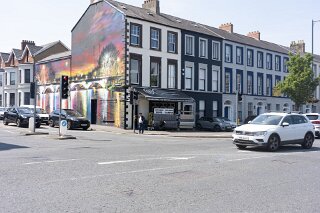
STREET ART BY DAN KITCHENER AT 135 ORMEAU ROAD
I found this mural by accident as I was trying to find a pharmacy and had been advised that there was one on Ormeau Road - I discuss this issue below.
At the junction of University Street and Ormeau Road in Belfast, there is a large and striking mural painted on the gable wall of 135 Ormeau Rd.
The Mural: "Reflections"
This artwork was created in March 2024 by the renowned London-based street artist Dan Kitchener (also known as "Dank").
The Subject: The massive freehand mural depicts a vibrant, rain-slicked nighttime scene of the historic Ormeau Bridge crossing the River Lagan.
The Style: Kitchener is celebrated globally for his "impressionistic street scene" style, often capturing rainy urban landscapes illuminated by neon lights and vehicle reflections. This piece features a dramatic sky of deep purples, oranges, and reds, with brilliant streetlights casting colourful reflections of blue, pink, and yellow onto the water.
Funding: The project was commissioned with support from the Department for Infrastructure and Belfast City Council as part of a vibrant business initiative to bring color and public art to the local streetscape.
Political Demographics of the Area
The area surrounding the junction of University Street and Ormeau Road is historically complex and has undergone significant demographic shifts over the last few decades. It is not classified as a singular "Unionist" area; rather, it sits at a transitional boundary.
Lower Ormeau Road
The mural itself is located in what is known as the Lower Ormeau.
Nationalist History: Historically, the Lower Ormeau Road has been a predominantly Nationalist/Republican working-class area. During the Troubles and the post-conflict parading disputes of the 1990s, the road was a notable flashpoint where local residents protested against Loyalist and Orange Order parades marching through the neighbourhood.
Upper Ormeau Road
If you travel south across the Ormeau Bridge toward Ballynafeigh, you enter the Upper Ormeau.
Mixed & Diverse: While Ballynafeigh was historically a more Protestant/Unionist enclave, the Upper Ormeau has evolved over the past few decades into one of the most integrated, multicultural, and politically mixed neighbourhoods in South Belfast. It is home to a diverse blend of Nationalist, Unionist, and international residents, as well as independent cafes, shops, and community initiatives.
University Street
University Street runs perpendicular to the Ormeau Road and serves as the northern boundary of the "Holyland" area.
Student/Mixed Area: The streets immediately south of University Street (Jerusalem Street, Palestine Street, Damascus Street, etc.) were originally developed in the late 19th century by a Unionist developer. Historically populated by working-class Protestant families, the entire area underwent a massive demographic shift from the 1990s onward due to the expansion of Queen's University Belfast.
Today, University Street and the Holylands are heavily mixed, transient student areas populated by young people from both Nationalist and Unionist backgrounds, alongside international students and young professionals.
Belfast: Bookmakers, Chemists, and the Ormeau Road
It is a basic expectation of modern urban life that if you are walking around a major city centre, you are never more than a few blocks away from a local pharmacy.
While out in Belfast recently, carrying the camera and documenting the changing built environment, I developed a nagging case of heat rash. I figured it would be a simple five-minute detour to find a local chemist, grab some quick treatment, and get back to shooting.
Instead, I found myself navigating a strange, jarring retail imbalance. I passed plenty of bright, neon-lit betting shops and bookies, but not a single chemist. In some parts of the city, it feels as though the high street has been completely re-engineered—where it is far easier to place a bet than it is to buy a simple tube of cream.
Squeezing out the Essentials
This lack of basic healthcare facilities isn't just a minor inconvenience; it is the physical symptom of a severe, quiet crisis. Community pharmacy numbers in Northern Ireland have recently plunged to their lowest level in a decade. While the sector has long grappled with a £20 million annual funding deficit, Brexit has acted as a massive accelerant to the decline.
Pharmacy Business
Post-Brexit regulatory friction has repeatedly disrupted supply chains, while the end of mutual recognition of qualifications with the EU has choked off the supply of cross-border locum pharmacists. Faced with skyrocketing staff costs, complex new transport logistics across the Irish Sea, and wholesale drug price inflation, many independent chemists have simply been squeezed out of existence. High-street bookmakers operate under lucrative commercial models that can easily absorb these economic shocks, but the vital, neighbourhood chemist has been left to wither.
The "double squeeze": Rising wholesale medicine costs due to Brexit supply chain shifts, coupled with a lack of cross-border locum cover, has made many independent Belfast pharmacies financially unviable.
An Unexpected Canvas on the Ormeau Road
Eventually, after wandering a bit aimlessly, I had to stop and ask a passerby for help. They pointed me toward the Ormeau Road, though they warned me with a shrug that the chemist there might not even be open anymore—a sad reflection of just how unpredictable these essential services have become for locals.
Luckily, fortune was on my side. Not only was the chemist open and able to sort out the heat rash, but the detour yielded an unexpected photographic bonus.
Right across the street, stretching across a brick wall at the junction with University Street, was a striking mural. It was "Reflections" by the street artist Dan Kitchener, depicting the nearby Ormeau Bridge beautifully illuminated at night, reflecting onto the dark waters of the River Lagan.
It was a reminder that even a frustrating, uncomfortable wild goose chase through a changing, post-Brexit city can end with a brilliant piece of street art.
At the junction of University Street and Ormeau Road in Belfast, there is a large and striking mural painted on the gable wall of 135 Ormeau Rd.
The Mural: "Reflections"
This artwork was created in March 2024 by the renowned London-based street artist Dan Kitchener (also known as "Dank").
The Subject: The massive freehand mural depicts a vibrant, rain-slicked nighttime scene of the historic Ormeau Bridge crossing the River Lagan.
The Style: Kitchener is celebrated globally for his "impressionistic street scene" style, often capturing rainy urban landscapes illuminated by neon lights and vehicle reflections. This piece features a dramatic sky of deep purples, oranges, and reds, with brilliant streetlights casting colourful reflections of blue, pink, and yellow onto the water.
Funding: The project was commissioned with support from the Department for Infrastructure and Belfast City Council as part of a vibrant business initiative to bring color and public art to the local streetscape.
Political Demographics of the Area
The area surrounding the junction of University Street and Ormeau Road is historically complex and has undergone significant demographic shifts over the last few decades. It is not classified as a singular "Unionist" area; rather, it sits at a transitional boundary.
Lower Ormeau Road
The mural itself is located in what is known as the Lower Ormeau.
Nationalist History: Historically, the Lower Ormeau Road has been a predominantly Nationalist/Republican working-class area. During the Troubles and the post-conflict parading disputes of the 1990s, the road was a notable flashpoint where local residents protested against Loyalist and Orange Order parades marching through the neighbourhood.
Upper Ormeau Road
If you travel south across the Ormeau Bridge toward Ballynafeigh, you enter the Upper Ormeau.
Mixed & Diverse: While Ballynafeigh was historically a more Protestant/Unionist enclave, the Upper Ormeau has evolved over the past few decades into one of the most integrated, multicultural, and politically mixed neighbourhoods in South Belfast. It is home to a diverse blend of Nationalist, Unionist, and international residents, as well as independent cafes, shops, and community initiatives.
University Street
University Street runs perpendicular to the Ormeau Road and serves as the northern boundary of the "Holyland" area.
Student/Mixed Area: The streets immediately south of University Street (Jerusalem Street, Palestine Street, Damascus Street, etc.) were originally developed in the late 19th century by a Unionist developer. Historically populated by working-class Protestant families, the entire area underwent a massive demographic shift from the 1990s onward due to the expansion of Queen's University Belfast.
Today, University Street and the Holylands are heavily mixed, transient student areas populated by young people from both Nationalist and Unionist backgrounds, alongside international students and young professionals.
Belfast: Bookmakers, Chemists, and the Ormeau Road
It is a basic expectation of modern urban life that if you are walking around a major city centre, you are never more than a few blocks away from a local pharmacy.
While out in Belfast recently, carrying the camera and documenting the changing built environment, I developed a nagging case of heat rash. I figured it would be a simple five-minute detour to find a local chemist, grab some quick treatment, and get back to shooting.
Instead, I found myself navigating a strange, jarring retail imbalance. I passed plenty of bright, neon-lit betting shops and bookies, but not a single chemist. In some parts of the city, it feels as though the high street has been completely re-engineered—where it is far easier to place a bet than it is to buy a simple tube of cream.
Squeezing out the Essentials
This lack of basic healthcare facilities isn't just a minor inconvenience; it is the physical symptom of a severe, quiet crisis. Community pharmacy numbers in Northern Ireland have recently plunged to their lowest level in a decade. While the sector has long grappled with a £20 million annual funding deficit, Brexit has acted as a massive accelerant to the decline.
Pharmacy Business
Post-Brexit regulatory friction has repeatedly disrupted supply chains, while the end of mutual recognition of qualifications with the EU has choked off the supply of cross-border locum pharmacists. Faced with skyrocketing staff costs, complex new transport logistics across the Irish Sea, and wholesale drug price inflation, many independent chemists have simply been squeezed out of existence. High-street bookmakers operate under lucrative commercial models that can easily absorb these economic shocks, but the vital, neighbourhood chemist has been left to wither.
The "double squeeze": Rising wholesale medicine costs due to Brexit supply chain shifts, coupled with a lack of cross-border locum cover, has made many independent Belfast pharmacies financially unviable.
An Unexpected Canvas on the Ormeau Road
Eventually, after wandering a bit aimlessly, I had to stop and ask a passerby for help. They pointed me toward the Ormeau Road, though they warned me with a shrug that the chemist there might not even be open anymore—a sad reflection of just how unpredictable these essential services have become for locals.
Luckily, fortune was on my side. Not only was the chemist open and able to sort out the heat rash, but the detour yielded an unexpected photographic bonus.
Right across the street, stretching across a brick wall at the junction with University Street, was a striking mural. It was "Reflections" by the street artist Dan Kitchener, depicting the nearby Ormeau Bridge beautifully illuminated at night, reflecting onto the dark waters of the River Lagan.
It was a reminder that even a frustrating, uncomfortable wild goose chase through a changing, post-Brexit city can end with a brilliant piece of street art.
MURAL AT 135 ORMEAU ROAD