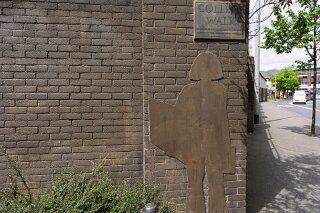
CAMOUFLAGED ART BY BETTY NEWMAN-MAGUIRE IN BELFAST CITY 9 JULY 2026
Hidden in Plain Sight: Finding Art in Belfast’s Gritty Shadows
We often think of public art as something that shouts for attention—giant stone monuments dominating open squares or brightly coloured murals claiming entire gable walls. But sometimes, the most impactful art is the kind that refuses to raise its voice. The kind that whispers from the corners we usually rush past.
While walking near College Avenue, I found myself in a corner of Belfast that feels suspended in limbo. On one side stands the glossy promise of the brand-new Belfast Grand Central Station—a towering, multi-million-pound transport hub of glass and steel that loudly declares Belfast’s modern ambitions.
Yet, turn your back on the station and walk just a stone's throw away into the historic Millfield area, and the atmosphere shifts. Millfield is gritty, undeniably run-down, and marked by decades of urban neglect. Cut off from the city centre's commercial pulse by the roaring traffic of the Westlink, this area has long carried a "rough" reputation. It is the kind of industrial, transitional space where people rarely linger. They are always on their way to somewhere else.
But because I was deliberately taking my time, I spotted something completely unexpected on a dull brick wall along College Walk.
The Camouflaged Shadows of College Walk
Mounted flush against a red brick wall—which someone has unfortunately painted over in a thick, flat brown—was a series of metal silhouettes.
These figures depict ordinary people frozen in moments of everyday transit: someone strolling to class, a person walking their dog, someone else heading home. Installed in 2003 by the prominent Irish sculptor Betty Newman-Maguire (who holds an MFA from the nearby University of Ulster), this site-specific work was originally commissioned by Belfast City Council to add a human, narrative element to a harsh pedestrian corridor.
Today, the installation is almost entirely lost to the elements. Years of weather, industrial grime, and layers of thoughtless brown paint have coated the metalwork until it matches the wall exactly. They have literally been painted into the background of the city.
While I was taking photographs of the wall—and mentally trying to adjust the contrast in my head to make the obscured figures visible—a passerby stopped and asked me what on earth I was photographing. When I pointed out the metal silhouettes, the person gasped. They told me they had walked past this exact brick wall every single day for years and had never once noticed that the metal figures existed.
The Irony of the "Municipal Buff"
Without inside knowledge of Belfast City Council’s maintenance logs, it is impossible to determine the actual reason or specific trigger for the effective erasure of what was undoubtedly a highly considered, expensive public art installation.
However, comparing my recent shots with older photographs of the street strongly suggests a classic urban tragedy: the "municipal buff."
In cities worldwide, third-party subcontractors are routinely hired to clean up graffiti, armed with rollers and massive tubs of cheap, utilitarian paint. Working quickly to meet square-footage targets, these crews rarely look closely at the walls they are blanking out. To a worker tasked with erasing tags along College Walk, Newman-Maguire's flush metal silhouettes likely just looked like raised architectural framing or old structural brackets. In a rush to sanitise the wall, they simply rolled right over them.
If so, the irony is biting: a piece of public art commissioned by the city to humanise the street was ultimately swallowed up by the blind, mechanical gears of the city’s own cleanup apparatus.
The Poignancy of a Hidden Crowd
There is a profound, quiet beauty to this neglect. In a pocket of Belfast that has historically been fractured and bypassed, Newman-Maguire’s figures act as a permanent, ghostly crowd. Though they are obscured by grime and paint, they stand as a monument to the thousands of ordinary commuters, students, and residents who have walked these pavements before us. Stumbling upon them feels like discovering a municipal secret—a quiet archive of human presence on a forgotten wall.
Urban exploration isn't just about admiring shiny new developments. If we don't take detours through the rougher, overlooked edges of our cities, we miss the very pieces that hold their artistic soul.
Next time you step out of the grand glass doors of the new station, don't just look up at the modern skyline. Take a quiet wander down the side streets of Millfield. You might find that if you look closely enough, the walls are watching you back.
Gear Discussion: Sony α7R VI + FE 24mm f/1.4 GM
Using the flagship Sony α7R VI paired with the stellar FE 24mm f/1.4 G Master lens is a masterclass setup for environmental portraiture, street photography, and urban exploration. Here is how this combination elevates this specific shoot:
Solving the Contrast Crisis (66.8 Megapixels): Newman-Maguire’s silhouettes are flat, painted-over, and practically melted into the brickwork. The massive 66.8MP Exmor RS stacked sensor of the α7R VI captures micro-textures and subtle tonal gradations in the painted brick that standard sensors would turn into mush. This extreme resolution gave you the dynamic range and "raw power" needed to pull the metal edges away from the brick when I doctored the images in post-production.
The 24mm f/1.4 GM Advantage:
Contextual Storytelling: A 24mm wide-angle is the perfect focal length for this story. It allows you to frame the tiny, hidden figures on the wall while keeping the gritty, towering environment of Millfield in the shot—providing critical spatial context.
The f/1.4 Separation: By shooting at a wide aperture like f/1.4 or f/2, you can create a subtle fall-off in depth of field. This gently separates the brick wall and the metal figures from the cluttered city background, drawing the viewer’s eye directly to the art.
Extreme Low-Light Capability: Millfield is a place of shadows, surrounded by tall buildings and underpasses. The light-gathering power of the f/1.4 aperture, combined with the camera's class-leading low-light autofocus (down to −6 EV) and improved high-ISO performance, ensures razor-sharp, noise-free handheld shots even in the dingiest alleyways.
This combination bridges the gap between raw documentarian street photography and high-end, gallery-quality art documentation.
We often think of public art as something that shouts for attention—giant stone monuments dominating open squares or brightly coloured murals claiming entire gable walls. But sometimes, the most impactful art is the kind that refuses to raise its voice. The kind that whispers from the corners we usually rush past.
While walking near College Avenue, I found myself in a corner of Belfast that feels suspended in limbo. On one side stands the glossy promise of the brand-new Belfast Grand Central Station—a towering, multi-million-pound transport hub of glass and steel that loudly declares Belfast’s modern ambitions.
Yet, turn your back on the station and walk just a stone's throw away into the historic Millfield area, and the atmosphere shifts. Millfield is gritty, undeniably run-down, and marked by decades of urban neglect. Cut off from the city centre's commercial pulse by the roaring traffic of the Westlink, this area has long carried a "rough" reputation. It is the kind of industrial, transitional space where people rarely linger. They are always on their way to somewhere else.
But because I was deliberately taking my time, I spotted something completely unexpected on a dull brick wall along College Walk.
The Camouflaged Shadows of College Walk
Mounted flush against a red brick wall—which someone has unfortunately painted over in a thick, flat brown—was a series of metal silhouettes.
These figures depict ordinary people frozen in moments of everyday transit: someone strolling to class, a person walking their dog, someone else heading home. Installed in 2003 by the prominent Irish sculptor Betty Newman-Maguire (who holds an MFA from the nearby University of Ulster), this site-specific work was originally commissioned by Belfast City Council to add a human, narrative element to a harsh pedestrian corridor.
Today, the installation is almost entirely lost to the elements. Years of weather, industrial grime, and layers of thoughtless brown paint have coated the metalwork until it matches the wall exactly. They have literally been painted into the background of the city.
While I was taking photographs of the wall—and mentally trying to adjust the contrast in my head to make the obscured figures visible—a passerby stopped and asked me what on earth I was photographing. When I pointed out the metal silhouettes, the person gasped. They told me they had walked past this exact brick wall every single day for years and had never once noticed that the metal figures existed.
The Irony of the "Municipal Buff"
Without inside knowledge of Belfast City Council’s maintenance logs, it is impossible to determine the actual reason or specific trigger for the effective erasure of what was undoubtedly a highly considered, expensive public art installation.
However, comparing my recent shots with older photographs of the street strongly suggests a classic urban tragedy: the "municipal buff."
In cities worldwide, third-party subcontractors are routinely hired to clean up graffiti, armed with rollers and massive tubs of cheap, utilitarian paint. Working quickly to meet square-footage targets, these crews rarely look closely at the walls they are blanking out. To a worker tasked with erasing tags along College Walk, Newman-Maguire's flush metal silhouettes likely just looked like raised architectural framing or old structural brackets. In a rush to sanitise the wall, they simply rolled right over them.
If so, the irony is biting: a piece of public art commissioned by the city to humanise the street was ultimately swallowed up by the blind, mechanical gears of the city’s own cleanup apparatus.
The Poignancy of a Hidden Crowd
There is a profound, quiet beauty to this neglect. In a pocket of Belfast that has historically been fractured and bypassed, Newman-Maguire’s figures act as a permanent, ghostly crowd. Though they are obscured by grime and paint, they stand as a monument to the thousands of ordinary commuters, students, and residents who have walked these pavements before us. Stumbling upon them feels like discovering a municipal secret—a quiet archive of human presence on a forgotten wall.
Urban exploration isn't just about admiring shiny new developments. If we don't take detours through the rougher, overlooked edges of our cities, we miss the very pieces that hold their artistic soul.
Next time you step out of the grand glass doors of the new station, don't just look up at the modern skyline. Take a quiet wander down the side streets of Millfield. You might find that if you look closely enough, the walls are watching you back.
Gear Discussion: Sony α7R VI + FE 24mm f/1.4 GM
Using the flagship Sony α7R VI paired with the stellar FE 24mm f/1.4 G Master lens is a masterclass setup for environmental portraiture, street photography, and urban exploration. Here is how this combination elevates this specific shoot:
Solving the Contrast Crisis (66.8 Megapixels): Newman-Maguire’s silhouettes are flat, painted-over, and practically melted into the brickwork. The massive 66.8MP Exmor RS stacked sensor of the α7R VI captures micro-textures and subtle tonal gradations in the painted brick that standard sensors would turn into mush. This extreme resolution gave you the dynamic range and "raw power" needed to pull the metal edges away from the brick when I doctored the images in post-production.
The 24mm f/1.4 GM Advantage:
Contextual Storytelling: A 24mm wide-angle is the perfect focal length for this story. It allows you to frame the tiny, hidden figures on the wall while keeping the gritty, towering environment of Millfield in the shot—providing critical spatial context.
The f/1.4 Separation: By shooting at a wide aperture like f/1.4 or f/2, you can create a subtle fall-off in depth of field. This gently separates the brick wall and the metal figures from the cluttered city background, drawing the viewer’s eye directly to the art.
Extreme Low-Light Capability: Millfield is a place of shadows, surrounded by tall buildings and underpasses. The light-gathering power of the f/1.4 aperture, combined with the camera's class-leading low-light autofocus (down to −6 EV) and improved high-ISO performance, ensures razor-sharp, noise-free handheld shots even in the dingiest alleyways.
This combination bridges the gap between raw documentarian street photography and high-end, gallery-quality art documentation.
PUBLIC ART AT COLLEGE WALK