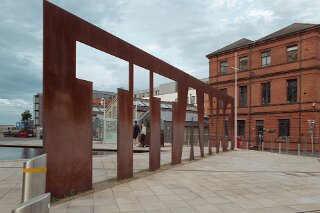
HEAVY METAL SIGN PHOTOGRAPHED USING A LEICA Q3
Breaking Habits and Finding New Perspectives
Breaking old travel habits is rarely a deliberate choice; more often than not, it is forced upon us by shifting logistics. For over two decades, my approach to visiting a familiar town or city followed a predictable, comfortable pattern: anchor myself in the exact same neighbourhood, and if possible, book the exact same hotel. It was a reliable formula that offered a known baseline.
Post-pandemic realities completely upended that model. The sudden rise of hyper-aggressive dynamic pricing and volatile room availability meant that old faithful options were either entirely booked or priced at a premium that defied logic. Forced out of a decades-long comfort zone, I had to adapt—and in doing so, stumbled into a much more rewarding way of exploring the built environment.
The Myth of the "Value" Option: Price Compression
One of the most surprising realisations from this forced flexibility is the collapse of the traditional value gap in modern hospitality.
When dynamic pricing algorithms take over, budget or mid-tier "value" hotels often experience massive price spikes during peak periods or major events. Because their baseline rates are lower, demand surges can drive their percentages up exponentially, making them nearly as expensive as premium, full-service properties.
When the price differential between a standard room and a significantly better-appointed hotel compresses to a narrow margin, the decision-making process changes. Paying a fractional premium for vastly superior comfort, space, and service becomes the logical choice, completely dismantling the argument for default budget chains.
Shifting Anchors: A New Lens on the City
Beyond the financial calculus, the real revelation has been geographic. Anchoring yourself in a different quadrant of a city changes your entire relationship with its streets. It alters your first morning view, your transit dependencies, and the ambient light you encounter at the beginning and end of a session.
Winter vs. Summer: A Tale of Two Locations
December at Brunswick Street (The Maldron): My choice here was purely logistical, driven by proximity to the new Grand Central Station hub. It was a familiar base—having stayed there just six months prior in May—and it served as an efficient launchpad for navigating the central core during the shorter winter days.
July at the Harbour (Marriott Residence Inn): For a summer visit leading up to the July Bank Holiday weekend, I shifted my strategy entirely. I chose the Residence Inn near the waterfront, trading central transit proximity for an isolated, industrial urban landscape.
The Geography of the Twelfth: Finding a Buffer
Choosing Belfast during this specific week requires a completely different set of tactical considerations. This is not a holiday weekend that attracts outsiders; because of the traditional bonfires and the distinct political atmosphere, visitors actively avoid the city, and nobody from the Republic would willingly choose to be there. By Friday, 10 July, the traditional annual shutdown was in full swing, with a significant number of restaurants closing their doors for a one- or two-week holiday as the local population cleared out.
Under these conditions, my usual base on Brunswick Street was out of the question. While highly convenient in December, its proximity to the city centre grid places it entirely too close to a number of known flashpoints. In the week leading up to the loyalist activities, several massive bonfire structures are constructed not far from Grand Central Station. For an independent street photographer from the Republic, the area transitions from a practical hub into an unsafe home base.
The sheer scale and inherent danger of these towering pyres are immense—underscored by the tragic reality of a fatal fall from a bonfire structure in the east of the city, and another severe incident where a row of terraced houses was engulfed in flames due to the proximity of a burning bonfire.
Moving across the river to the Titanic Quarter was a deliberate strategic pivot. The harbour district is vastly more isolated, surrounded by large industrial sites that effectively act as physical buffers from the city's traditional sectarian geography.
The move did bring operational trade-offs: I already knew the Glider G2 service could be frustratingly unreliable, and the lack of basic amenities or open businesses in a post-industrial district after 7 PM becomes incredibly stark when the rest of the city is winding down for the Twelfth.
Yet, from a documentary perspective, the gamble paid off brilliantly. While the city centre felt the vacuum of the holiday closures and the tension of the upcoming events, the quieted, buffered docklands offered an undisturbed, secure look at the built environment. By intentionally placing myself away from the familiar Brunswick street grid and utilising the industrial layout to my advantage, I was forced into a completely different daily trajectory. The empty streets of the harbour district allowed me to explore and record its architectural evolution, industrial heritage, and changing spatial layout in far greater depth and peace of mind than any standard visit could ever provide.
Ultimately, what began as a frustrating necessity forced by hotel algorithms has become a vital tool in my workflow. Changing where you sleep is the easiest way to guarantee you see familiar streets with entirely fresh—and safe—eyes.
The Sign And The Location
In the decade and a half since the revitalisation of Belfast’s historic Queen’s Island, weathering steel—popularly known by its original brand name, Corten—has transitioned from a specialised, industrial design material into a defining feature of the contemporary Irish urban landscape. What began as a deliberate, heavy-industry design cue in the Titanic Quarter can now be seen across the island of Ireland, from public transport hubs and civic spaces to boundary walls and artistic interventions.
The Belfast Titanic Sign: Anchored in History
Unveiled in 2012 to coincide with the opening of the landmark Titanic Belfast visitor centre and the centenary of the ship's fateful voyage, the iconic Titanic Sign serves as an intentional piece of public art and industrial symbolism. Commissioned by Titanic Quarter Ltd and the Northern Ireland Tourist Board, the sign was integrated into the public realm layout on Olympic Way by Eric R. Kuhne and Associates alongside Todd Architects.
Rather than a standard fabricated sheet, the sign is a monolith of 2.5-centimetre-thick steel plate with stencilled, cut-out lettering spelling the ship's name. It carries an extraordinary physical weight of 16 tonnes—a number specifically chosen by the designers because it matches the exact weight of the original forward anchor carried on the fo'c'sle deck of the RMS Titanic.
By choosing a material that oxidises rather than stays pristine, the designers created a direct material narrative. The sign changes hue in response to the famously unpredictable, rain-heavy Northern Irish weather. On a bright, damp afternoon, the deep burnt-orange surface darkens, catching environmental reflections off the wet pavement and standing in stark contrast to the shimmering, geometric, silver-white aluminium skin of the main building behind it.
The Industrial Resonance of Weathered Steel
Weathering steel is a group of steel alloys developed to eliminate the need for painting. When exposed to the elements for a few years, it forms a stable, dense, and self-protecting rust-like layer—the patina—across its surface.
From an engineering and urban planning perspective, its adoption throughout Ireland is driven by several practical and aesthetic advantages:
Low Maintenance: The stable oxide layer acts as a barrier, regenerating if scratched or chipped. This effectively halts deep structural corrosion, completely eliminating the recurring costs and labour of sandblasting or painting.
The Patina Transition: Over an initial exposure period of 18 to 36 months, the steel undergoes a striking colour evolution. It shifts from a raw, industrial silver-grey to a bright orange-ochre, before finally settling into a rich, velvety, dark-brown chestnut shade.
Contextual Harmony: Unlike galvanised steel or bright powder coatings, weathered steel carries an organic texture. It blends effortlessly into both natural parklands and older, historic brickwork settings, making it highly attractive to local authority planners.
From Shipyards to Civil Spaces: The Irish Trend
Following the success of the Titanic Quarter installations—which include not just the main sign but also the weathered steel roofs of the nearby Public Record Office of Northern Ireland (PRONI) and the interpretive signage on the SS Nomadic—the material's popularity exploded across Ireland.
In Dublin, Cork, Galway, and smaller rural towns, local authorities and architects have embraced it for everything from urban wayfinding panels and planters to entire building facades. Its rustic look has become shorthand for "heritage meets modernity." However, its widespread use across the island has taught designers a few vital engineering lessons regarding regional weather conditions:
The Rust Staining Trap: During the initial bleeding phase, rainfall washes loose oxide particles off the steel. If a Corten sign or pillar is mounted directly onto light-coloured Irish limestone, granite, or porous concrete pavements without hidden drainage channels or catch-trays, it leaves permanent, unsightly orange streaks on the ground ground-plane.
The Marine Environment Factor: Weathering steel relies on alternating wet and dry cycles to build its protective patina. In coastal areas subject to continuous, salt-laden marine air and sea spray, the salt can prevent the stable oxide barrier from forming properly, leading to advanced, destructive scaling if the specific alloy grade isn't carefully specified.
Despite these installation challenges, weathered steel remains a deeply evocative material choice. When used correctly, it acts as a bridge between Ireland’s heavy industrial past and its progressive, modern architecture, turning standard street signs and structural panels into living, weathering canvases that tell a story of time and exposure.
Breaking old travel habits is rarely a deliberate choice; more often than not, it is forced upon us by shifting logistics. For over two decades, my approach to visiting a familiar town or city followed a predictable, comfortable pattern: anchor myself in the exact same neighbourhood, and if possible, book the exact same hotel. It was a reliable formula that offered a known baseline.
Post-pandemic realities completely upended that model. The sudden rise of hyper-aggressive dynamic pricing and volatile room availability meant that old faithful options were either entirely booked or priced at a premium that defied logic. Forced out of a decades-long comfort zone, I had to adapt—and in doing so, stumbled into a much more rewarding way of exploring the built environment.
The Myth of the "Value" Option: Price Compression
One of the most surprising realisations from this forced flexibility is the collapse of the traditional value gap in modern hospitality.
When dynamic pricing algorithms take over, budget or mid-tier "value" hotels often experience massive price spikes during peak periods or major events. Because their baseline rates are lower, demand surges can drive their percentages up exponentially, making them nearly as expensive as premium, full-service properties.
When the price differential between a standard room and a significantly better-appointed hotel compresses to a narrow margin, the decision-making process changes. Paying a fractional premium for vastly superior comfort, space, and service becomes the logical choice, completely dismantling the argument for default budget chains.
Shifting Anchors: A New Lens on the City
Beyond the financial calculus, the real revelation has been geographic. Anchoring yourself in a different quadrant of a city changes your entire relationship with its streets. It alters your first morning view, your transit dependencies, and the ambient light you encounter at the beginning and end of a session.
Winter vs. Summer: A Tale of Two Locations
December at Brunswick Street (The Maldron): My choice here was purely logistical, driven by proximity to the new Grand Central Station hub. It was a familiar base—having stayed there just six months prior in May—and it served as an efficient launchpad for navigating the central core during the shorter winter days.
July at the Harbour (Marriott Residence Inn): For a summer visit leading up to the July Bank Holiday weekend, I shifted my strategy entirely. I chose the Residence Inn near the waterfront, trading central transit proximity for an isolated, industrial urban landscape.
The Geography of the Twelfth: Finding a Buffer
Choosing Belfast during this specific week requires a completely different set of tactical considerations. This is not a holiday weekend that attracts outsiders; because of the traditional bonfires and the distinct political atmosphere, visitors actively avoid the city, and nobody from the Republic would willingly choose to be there. By Friday, 10 July, the traditional annual shutdown was in full swing, with a significant number of restaurants closing their doors for a one- or two-week holiday as the local population cleared out.
Under these conditions, my usual base on Brunswick Street was out of the question. While highly convenient in December, its proximity to the city centre grid places it entirely too close to a number of known flashpoints. In the week leading up to the loyalist activities, several massive bonfire structures are constructed not far from Grand Central Station. For an independent street photographer from the Republic, the area transitions from a practical hub into an unsafe home base.
The sheer scale and inherent danger of these towering pyres are immense—underscored by the tragic reality of a fatal fall from a bonfire structure in the east of the city, and another severe incident where a row of terraced houses was engulfed in flames due to the proximity of a burning bonfire.
Moving across the river to the Titanic Quarter was a deliberate strategic pivot. The harbour district is vastly more isolated, surrounded by large industrial sites that effectively act as physical buffers from the city's traditional sectarian geography.
The move did bring operational trade-offs: I already knew the Glider G2 service could be frustratingly unreliable, and the lack of basic amenities or open businesses in a post-industrial district after 7 PM becomes incredibly stark when the rest of the city is winding down for the Twelfth.
Yet, from a documentary perspective, the gamble paid off brilliantly. While the city centre felt the vacuum of the holiday closures and the tension of the upcoming events, the quieted, buffered docklands offered an undisturbed, secure look at the built environment. By intentionally placing myself away from the familiar Brunswick street grid and utilising the industrial layout to my advantage, I was forced into a completely different daily trajectory. The empty streets of the harbour district allowed me to explore and record its architectural evolution, industrial heritage, and changing spatial layout in far greater depth and peace of mind than any standard visit could ever provide.
Ultimately, what began as a frustrating necessity forced by hotel algorithms has become a vital tool in my workflow. Changing where you sleep is the easiest way to guarantee you see familiar streets with entirely fresh—and safe—eyes.
The Sign And The Location
In the decade and a half since the revitalisation of Belfast’s historic Queen’s Island, weathering steel—popularly known by its original brand name, Corten—has transitioned from a specialised, industrial design material into a defining feature of the contemporary Irish urban landscape. What began as a deliberate, heavy-industry design cue in the Titanic Quarter can now be seen across the island of Ireland, from public transport hubs and civic spaces to boundary walls and artistic interventions.
The Belfast Titanic Sign: Anchored in History
Unveiled in 2012 to coincide with the opening of the landmark Titanic Belfast visitor centre and the centenary of the ship's fateful voyage, the iconic Titanic Sign serves as an intentional piece of public art and industrial symbolism. Commissioned by Titanic Quarter Ltd and the Northern Ireland Tourist Board, the sign was integrated into the public realm layout on Olympic Way by Eric R. Kuhne and Associates alongside Todd Architects.
Rather than a standard fabricated sheet, the sign is a monolith of 2.5-centimetre-thick steel plate with stencilled, cut-out lettering spelling the ship's name. It carries an extraordinary physical weight of 16 tonnes—a number specifically chosen by the designers because it matches the exact weight of the original forward anchor carried on the fo'c'sle deck of the RMS Titanic.
By choosing a material that oxidises rather than stays pristine, the designers created a direct material narrative. The sign changes hue in response to the famously unpredictable, rain-heavy Northern Irish weather. On a bright, damp afternoon, the deep burnt-orange surface darkens, catching environmental reflections off the wet pavement and standing in stark contrast to the shimmering, geometric, silver-white aluminium skin of the main building behind it.
The Industrial Resonance of Weathered Steel
Weathering steel is a group of steel alloys developed to eliminate the need for painting. When exposed to the elements for a few years, it forms a stable, dense, and self-protecting rust-like layer—the patina—across its surface.
From an engineering and urban planning perspective, its adoption throughout Ireland is driven by several practical and aesthetic advantages:
Low Maintenance: The stable oxide layer acts as a barrier, regenerating if scratched or chipped. This effectively halts deep structural corrosion, completely eliminating the recurring costs and labour of sandblasting or painting.
The Patina Transition: Over an initial exposure period of 18 to 36 months, the steel undergoes a striking colour evolution. It shifts from a raw, industrial silver-grey to a bright orange-ochre, before finally settling into a rich, velvety, dark-brown chestnut shade.
Contextual Harmony: Unlike galvanised steel or bright powder coatings, weathered steel carries an organic texture. It blends effortlessly into both natural parklands and older, historic brickwork settings, making it highly attractive to local authority planners.
From Shipyards to Civil Spaces: The Irish Trend
Following the success of the Titanic Quarter installations—which include not just the main sign but also the weathered steel roofs of the nearby Public Record Office of Northern Ireland (PRONI) and the interpretive signage on the SS Nomadic—the material's popularity exploded across Ireland.
In Dublin, Cork, Galway, and smaller rural towns, local authorities and architects have embraced it for everything from urban wayfinding panels and planters to entire building facades. Its rustic look has become shorthand for "heritage meets modernity." However, its widespread use across the island has taught designers a few vital engineering lessons regarding regional weather conditions:
The Rust Staining Trap: During the initial bleeding phase, rainfall washes loose oxide particles off the steel. If a Corten sign or pillar is mounted directly onto light-coloured Irish limestone, granite, or porous concrete pavements without hidden drainage channels or catch-trays, it leaves permanent, unsightly orange streaks on the ground ground-plane.
The Marine Environment Factor: Weathering steel relies on alternating wet and dry cycles to build its protective patina. In coastal areas subject to continuous, salt-laden marine air and sea spray, the salt can prevent the stable oxide barrier from forming properly, leading to advanced, destructive scaling if the specific alloy grade isn't carefully specified.
Despite these installation challenges, weathered steel remains a deeply evocative material choice. When used correctly, it acts as a bridge between Ireland’s heavy industrial past and its progressive, modern architecture, turning standard street signs and structural panels into living, weathering canvases that tell a story of time and exposure.
HEAVY METAL SIGN