DEAD TREE SCULPTURES AT ORMEAU PARK IN BELFAST
THE GUARDIAN OF THE OAKS AND OTHER WOOD CARVINGS [ORMEAU PARK 9 JULY 2026]
While the formal paths and Victorian masonry of Ormeau Park may occasionally hint at the realities of strict municipal spending caps, the park's horticultural and natural elements remain a deeply respected asset. The most striking manifestation of this care is its collection of public folk art: a series of site-specific wood carvings that transform standard tree maintenance into an ecological narrative.
Rather than uprooting deadwood or extracting storm-damaged trunks at significant cost, Belfast City Council has embraced adaptive reuse. By leaving select stumps intact and inviting local chainsaw artists—most notably the Northern Irish carver known as "Haze" (Michael Winters)—the park has turned architectural and natural scars into complex, textured focal points that celebrate local biodiversity.
The Focal Piece: "The Guardian of the Oaks"
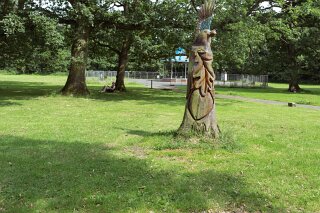
The undisputed centrepiece of Ormeau Park’s tree carvings stands along the perimeter of the older, mature wooded paths. While casual passers-by frequently mistake it for an eagle or a generic bird of prey due to its dominant scale, sharp profile, and commanding vertical perch, the sculpture is a highly intentional rendering of a Eurasian Jay.
1. Structural and Photographic Technique
Carved directly into the remaining heartwood of a massive felled tree, the piece exemplifies the raw, high-contrast texture characteristic of professional chainsaw art. The deep, directional gouges define the bird's distinct crest and wing covert layers, creating a highly tactile surface. For photographers working with handheld setups under the changing canopy, the coarse grain catches low-angle sunlight perfectly, emphasising the weathered, organic geometry of the wood.
2. Deep Ecological Symbolism
The choice of a Eurasian Jay carries profound environmental significance. Often referred to by arborists and conservationists as the "gardener of the forest," the Jay is famous for its intensive caching behavior during autumn, where a single bird can hoard and bury thousands of acorns across a wide geographical radius to secure winter food.
Because Jays inevitably fail to recover a substantial percentage of these hidden caches, they act as the primary, inadvertent planters of native oak woodlands. In the beak of Haze's sculpture lies a single, prominent acorn. This minute detail contextualises the entire piece: it is a monument to natural forest regeneration and a silent conservation statement regarding the historical loss and slow recovery of native oak canopies across Ireland and the UK.
The Playground Installations
Further into the park, situated directly on the lawn adjacent to the children’s playground fencing, the carving initiative shifts from grand ecological monuments to imaginative, standalone pieces carved from local timber. Rather than generic seating, these two installations introduce specific fantasy and playful motifs:
The Mythological Storyteller's Chair: A heavy, throne-like chair meticulously carved from a massive single trunk section
The design features a tall backrest punctuated by a striking circular cutout window, spanning which is a carved flying creature or small dragon with outspread wings. Nestled directly beneath the seat at the base of the structure is a beautifully detailed coiled dragon, complete with a resting snout and textured, layered body. The top corners of the backrest are finished with two geometric, faceted finials, while the solid side panels serve as heavy, protective armrests.
The Three-Bear Totem: Positioned nearby on a low log base is a whimsical vertical sculpture composed of three teddy bears stacked directly on top of each other. Carved with expressive, chunky chainsaw strokes that highlight the natural vertical grain and deep checking of the wood, this stacked figure stands as a welcoming, playful marker along the edge of the active play area.
Through this combination of heavy fantasy elements and major symbolic works like the Eurasian Jay, Ormeau Park’s timber management successfully illustrates how sensitive urban planning can turn routine maintenance liabilities into lasting cultural monuments.
While the formal paths and Victorian masonry of Ormeau Park may occasionally hint at the realities of strict municipal spending caps, the park's horticultural and natural elements remain a deeply respected asset. The most striking manifestation of this care is its collection of public folk art: a series of site-specific wood carvings that transform standard tree maintenance into an ecological narrative.
Rather than uprooting deadwood or extracting storm-damaged trunks at significant cost, Belfast City Council has embraced adaptive reuse. By leaving select stumps intact and inviting local chainsaw artists—most notably the Northern Irish carver known as "Haze" (Michael Winters)—the park has turned architectural and natural scars into complex, textured focal points that celebrate local biodiversity.
The Focal Piece: "The Guardian of the Oaks"
The undisputed centrepiece of Ormeau Park’s tree carvings stands along the perimeter of the older, mature wooded paths. While casual passers-by frequently mistake it for an eagle or a generic bird of prey due to its dominant scale, sharp profile, and commanding vertical perch, the sculpture is a highly intentional rendering of a Eurasian Jay.
1. Structural and Photographic Technique
Carved directly into the remaining heartwood of a massive felled tree, the piece exemplifies the raw, high-contrast texture characteristic of professional chainsaw art. The deep, directional gouges define the bird's distinct crest and wing covert layers, creating a highly tactile surface. For photographers working with handheld setups under the changing canopy, the coarse grain catches low-angle sunlight perfectly, emphasising the weathered, organic geometry of the wood.
2. Deep Ecological Symbolism
The choice of a Eurasian Jay carries profound environmental significance. Often referred to by arborists and conservationists as the "gardener of the forest," the Jay is famous for its intensive caching behavior during autumn, where a single bird can hoard and bury thousands of acorns across a wide geographical radius to secure winter food.
Because Jays inevitably fail to recover a substantial percentage of these hidden caches, they act as the primary, inadvertent planters of native oak woodlands. In the beak of Haze's sculpture lies a single, prominent acorn. This minute detail contextualises the entire piece: it is a monument to natural forest regeneration and a silent conservation statement regarding the historical loss and slow recovery of native oak canopies across Ireland and the UK.
The Playground Installations
Further into the park, situated directly on the lawn adjacent to the children’s playground fencing, the carving initiative shifts from grand ecological monuments to imaginative, standalone pieces carved from local timber. Rather than generic seating, these two installations introduce specific fantasy and playful motifs:
The Mythological Storyteller's Chair: A heavy, throne-like chair meticulously carved from a massive single trunk section
The design features a tall backrest punctuated by a striking circular cutout window, spanning which is a carved flying creature or small dragon with outspread wings. Nestled directly beneath the seat at the base of the structure is a beautifully detailed coiled dragon, complete with a resting snout and textured, layered body. The top corners of the backrest are finished with two geometric, faceted finials, while the solid side panels serve as heavy, protective armrests.
The Three-Bear Totem: Positioned nearby on a low log base is a whimsical vertical sculpture composed of three teddy bears stacked directly on top of each other. Carved with expressive, chunky chainsaw strokes that highlight the natural vertical grain and deep checking of the wood, this stacked figure stands as a welcoming, playful marker along the edge of the active play area.
Through this combination of heavy fantasy elements and major symbolic works like the Eurasian Jay, Ormeau Park’s timber management successfully illustrates how sensitive urban planning can turn routine maintenance liabilities into lasting cultural monuments.
WOOD CARVINGS