PHOTOGRAPHED USING A LEICA Q3 CAMERA
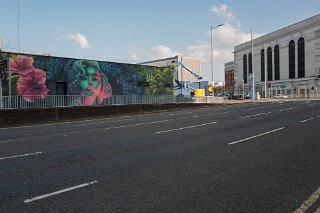
H.M.CONSTANCE IS RESPONSIBLE FOR THIS ATTRACTIVE CONTEMPORARY MURAL [GREAT PATRICK STREET IN BELFAST]
This striking piece of contemporary street art is located along Great Patrick Street in Belfast, situated immediately adjacent to the Ulster University (UU) Belfast campus.
The large white structure dominating the background to the right is the modern building complex that characterises this rejuvenated district, situated near the corner of Nelson Street and Great Patrick Street. This major multi-use complex features large accommodation blocks and is well known for housing a prominent premier hotel alongside commercial properties and local culinary staples, including the popular House of Zen restaurant.
When I visited Belfast for a week in July 2026 I brought my Leica Q3 with me as a backup to the Sony A7RVI but I must mention that I had an unexpected problem, a runaway software loop, which is discussed below. To describe the Q3 as a backup is not really fair but I cannot fully trust especially as the geotagging is unreliable.
Subject Matter and Style
The Central Figure: The mural features a bold, contemporary pop-art reimagining of Hollywood icon Marilyn Monroe, recognisable by her classic wavy hairstyle, facial structure, and glamorous expression.
Colour Palette: Rather than traditional tones, the portrait uses an expressionist, high-contrast neon palette dominated by electric greens, vivid pinks, and deep teals.
Botanical Framing: The subject is framed by contrasting organic elements. On the left, massive, multi-coloured pink hibiscus flowers bloom against the dark, textured brick wall. On the right, the mural transitions into a lush, dense canopy of tropical jungle foliage and green fronds, blending urban grit with a vibrant natural aesthetic.
The Artist: HMC (H.M. Constance)
The three letters HMC visible towards the top right of the artwork serve as the definitive signature tag for H.M. Constance (Hannah Constance), a prominent contemporary street artist based in Belfast.
Background: Hannah graduated with a BA (Hons) in Fine Art and has become a vital figure in Belfast's modern, post-conflict urban art movement. Her work is frequently featured in local street art events, including the city's annual Hit the North festival.
Artistic Vision: Her signature style focuses heavily on a vibrant, highly saturated colour palette. She is known for intertwining human or cultural subjects with rich elements of nature, animals, and botanical foliage—a philosophy perfectly exemplified by the synthesis of the pop-art portrait and lush tropical greenery seen here. This piece represents Belfast's ongoing cultural evolution, moving beyond historic political murals to embrace international pop art, urban rejuvenation, and modern creative expression.
Photographic Note
The image beautifully captures the exceptional resolving power of the Leica Q3. The 28mm Summilux lens manages to hold sharp contrast across the gritty asphalt of Great Patrick Street in the foreground, the fine lines of the razor wire overhead, and the intense colour saturation of the mural without blowing out the highlights of the bright sky or the white complex in the background.
The Technical Trap: Why Your "Off" Camera Can Still Overheat and Drain Overnight
As photographers, we trust that when we flip a camera’s power switch to Off, the device stops drawing power. However, modern mirrorless systems—including flagship bodies and premium compacts like the Leica Q3—no longer use a physical, mechanical circuit breaker. Instead, the power switch sends a digital command telling the internal operating system to execute a shutdown sequence and enter a deep sleep state.
If you have ever picked up your camera after a session only to find it burning hot to the touch and the battery completely exhausted, you have experienced a runaway software loop.
Here is a breakdown of why this happens, the potential risks during transit, and how to safeguard your gear.
The Cause: The Runaway Shutdown Sequence
When you turn off a modern camera, it does not instantly lose power. Under the hood, the processor is often working through a queue of background tasks:
Finalising buffered image writes to the SD card.
Updating internal databases and file logs.
Maintaining a wireless standby handshake with mobile apps (such as Leica FOTOS) via Bluetooth or Wi-Fi.
If the camera encounters a software glitch, a corrupted file write, or an interrupted wireless connection exactly as it attempts to shut down, the operating system can get trapped in an infinite processing loop. Because the camera is technically "off," its standard thermal throttling protocols may fail to kick in. The processor runs at maximum capacity, drawing continuous current and generating intense heat until the battery is entirely drained.
The Danger in the Camera Bag
While a camera overheating on a desk or hotel table is frustrating, the scenario becomes genuinely dangerous if the body is packed tightly inside a padded camera bag, flight case, or suitcase.
Without airflow, the heat generated by a runaway processor has nowhere to escape. This extreme thermal buildup can lead to:
Sensor degradation or damage to delicate internal adhesives.
Accelerated battery degradation or swelling.
In extreme cases, a potential fire hazard inside an enclosed, unmonitored luggage compartment.
Field-Tested Solutions for the Leica Q3
Because the Leica Q3 utilises the BP-SCL6 battery, the base of the battery itself acts as the camera's physical bottom plate. Simply removing the battery leaves the internal contact pins and locking mechanism completely exposed to dust, lint, and moisture.
To safely isolate the camera's power supply during transit without compromising its environmental sealing, employ these practical solutions:
1. The Contact Isolation Method (The "Card Trick")
If you want to leave the battery inside the chamber to maintain the weather seal, cut a small, clean strip of thin cardstock or heavy paper. Open the battery latch, drop the paper strip into the chamber to physically block the gold terminal contact pins, and slide the battery back into place. This physically breaks the electrical circuit, making an accidental power draw impossible while keeping the baseplate perfectly sealed.
2. Use a Dedicated Terminal Chamber Cap
Leica produces a specific plastic terminal cover designed to slide into an empty battery slot. This cap replicates the top profile of the battery, sealing the internal chamber from the elements during transit while the actual battery travels safely in a separate pouch.
3. Break the Wireless Link
A frequent trigger for shutdown loops is the camera attempting to maintain a background connection to your smartphone. Before packing your camera away for long-distance travel, turn on Flight Mode in the connectivity settings to completely disable Wi-Fi and Bluetooth handshakes.
4. Let the Camera "Breathe" Before Storage
After a heavy shooting session, avoid switching the camera off and instantly burying it in a tight bag. Give the body a minute or two on a flat surface to finish its background operations, clear its buffer, and cool down naturally before packing it away.
This striking piece of contemporary street art is located along Great Patrick Street in Belfast, situated immediately adjacent to the Ulster University (UU) Belfast campus.
The large white structure dominating the background to the right is the modern building complex that characterises this rejuvenated district, situated near the corner of Nelson Street and Great Patrick Street. This major multi-use complex features large accommodation blocks and is well known for housing a prominent premier hotel alongside commercial properties and local culinary staples, including the popular House of Zen restaurant.
When I visited Belfast for a week in July 2026 I brought my Leica Q3 with me as a backup to the Sony A7RVI but I must mention that I had an unexpected problem, a runaway software loop, which is discussed below. To describe the Q3 as a backup is not really fair but I cannot fully trust especially as the geotagging is unreliable.
Subject Matter and Style
The Central Figure: The mural features a bold, contemporary pop-art reimagining of Hollywood icon Marilyn Monroe, recognisable by her classic wavy hairstyle, facial structure, and glamorous expression.
Colour Palette: Rather than traditional tones, the portrait uses an expressionist, high-contrast neon palette dominated by electric greens, vivid pinks, and deep teals.
Botanical Framing: The subject is framed by contrasting organic elements. On the left, massive, multi-coloured pink hibiscus flowers bloom against the dark, textured brick wall. On the right, the mural transitions into a lush, dense canopy of tropical jungle foliage and green fronds, blending urban grit with a vibrant natural aesthetic.
The Artist: HMC (H.M. Constance)
The three letters HMC visible towards the top right of the artwork serve as the definitive signature tag for H.M. Constance (Hannah Constance), a prominent contemporary street artist based in Belfast.
Background: Hannah graduated with a BA (Hons) in Fine Art and has become a vital figure in Belfast's modern, post-conflict urban art movement. Her work is frequently featured in local street art events, including the city's annual Hit the North festival.
Artistic Vision: Her signature style focuses heavily on a vibrant, highly saturated colour palette. She is known for intertwining human or cultural subjects with rich elements of nature, animals, and botanical foliage—a philosophy perfectly exemplified by the synthesis of the pop-art portrait and lush tropical greenery seen here. This piece represents Belfast's ongoing cultural evolution, moving beyond historic political murals to embrace international pop art, urban rejuvenation, and modern creative expression.
Photographic Note
The image beautifully captures the exceptional resolving power of the Leica Q3. The 28mm Summilux lens manages to hold sharp contrast across the gritty asphalt of Great Patrick Street in the foreground, the fine lines of the razor wire overhead, and the intense colour saturation of the mural without blowing out the highlights of the bright sky or the white complex in the background.
The Technical Trap: Why Your "Off" Camera Can Still Overheat and Drain Overnight
As photographers, we trust that when we flip a camera’s power switch to Off, the device stops drawing power. However, modern mirrorless systems—including flagship bodies and premium compacts like the Leica Q3—no longer use a physical, mechanical circuit breaker. Instead, the power switch sends a digital command telling the internal operating system to execute a shutdown sequence and enter a deep sleep state.
If you have ever picked up your camera after a session only to find it burning hot to the touch and the battery completely exhausted, you have experienced a runaway software loop.
Here is a breakdown of why this happens, the potential risks during transit, and how to safeguard your gear.
The Cause: The Runaway Shutdown Sequence
When you turn off a modern camera, it does not instantly lose power. Under the hood, the processor is often working through a queue of background tasks:
Finalising buffered image writes to the SD card.
Updating internal databases and file logs.
Maintaining a wireless standby handshake with mobile apps (such as Leica FOTOS) via Bluetooth or Wi-Fi.
If the camera encounters a software glitch, a corrupted file write, or an interrupted wireless connection exactly as it attempts to shut down, the operating system can get trapped in an infinite processing loop. Because the camera is technically "off," its standard thermal throttling protocols may fail to kick in. The processor runs at maximum capacity, drawing continuous current and generating intense heat until the battery is entirely drained.
The Danger in the Camera Bag
While a camera overheating on a desk or hotel table is frustrating, the scenario becomes genuinely dangerous if the body is packed tightly inside a padded camera bag, flight case, or suitcase.
Without airflow, the heat generated by a runaway processor has nowhere to escape. This extreme thermal buildup can lead to:
Sensor degradation or damage to delicate internal adhesives.
Accelerated battery degradation or swelling.
In extreme cases, a potential fire hazard inside an enclosed, unmonitored luggage compartment.
Field-Tested Solutions for the Leica Q3
Because the Leica Q3 utilises the BP-SCL6 battery, the base of the battery itself acts as the camera's physical bottom plate. Simply removing the battery leaves the internal contact pins and locking mechanism completely exposed to dust, lint, and moisture.
To safely isolate the camera's power supply during transit without compromising its environmental sealing, employ these practical solutions:
1. The Contact Isolation Method (The "Card Trick")
If you want to leave the battery inside the chamber to maintain the weather seal, cut a small, clean strip of thin cardstock or heavy paper. Open the battery latch, drop the paper strip into the chamber to physically block the gold terminal contact pins, and slide the battery back into place. This physically breaks the electrical circuit, making an accidental power draw impossible while keeping the baseplate perfectly sealed.
2. Use a Dedicated Terminal Chamber Cap
Leica produces a specific plastic terminal cover designed to slide into an empty battery slot. This cap replicates the top profile of the battery, sealing the internal chamber from the elements during transit while the actual battery travels safely in a separate pouch.
3. Break the Wireless Link
A frequent trigger for shutdown loops is the camera attempting to maintain a background connection to your smartphone. Before packing your camera away for long-distance travel, turn on Flight Mode in the connectivity settings to completely disable Wi-Fi and Bluetooth handshakes.
4. Let the Camera "Breathe" Before Storage
After a heavy shooting session, avoid switching the camera off and instantly burying it in a tight bag. Give the body a minute or two on a flat surface to finish its background operations, clear its buffer, and cool down naturally before packing it away.
MONROE MURAL ON GREAT PATRICK STREET